


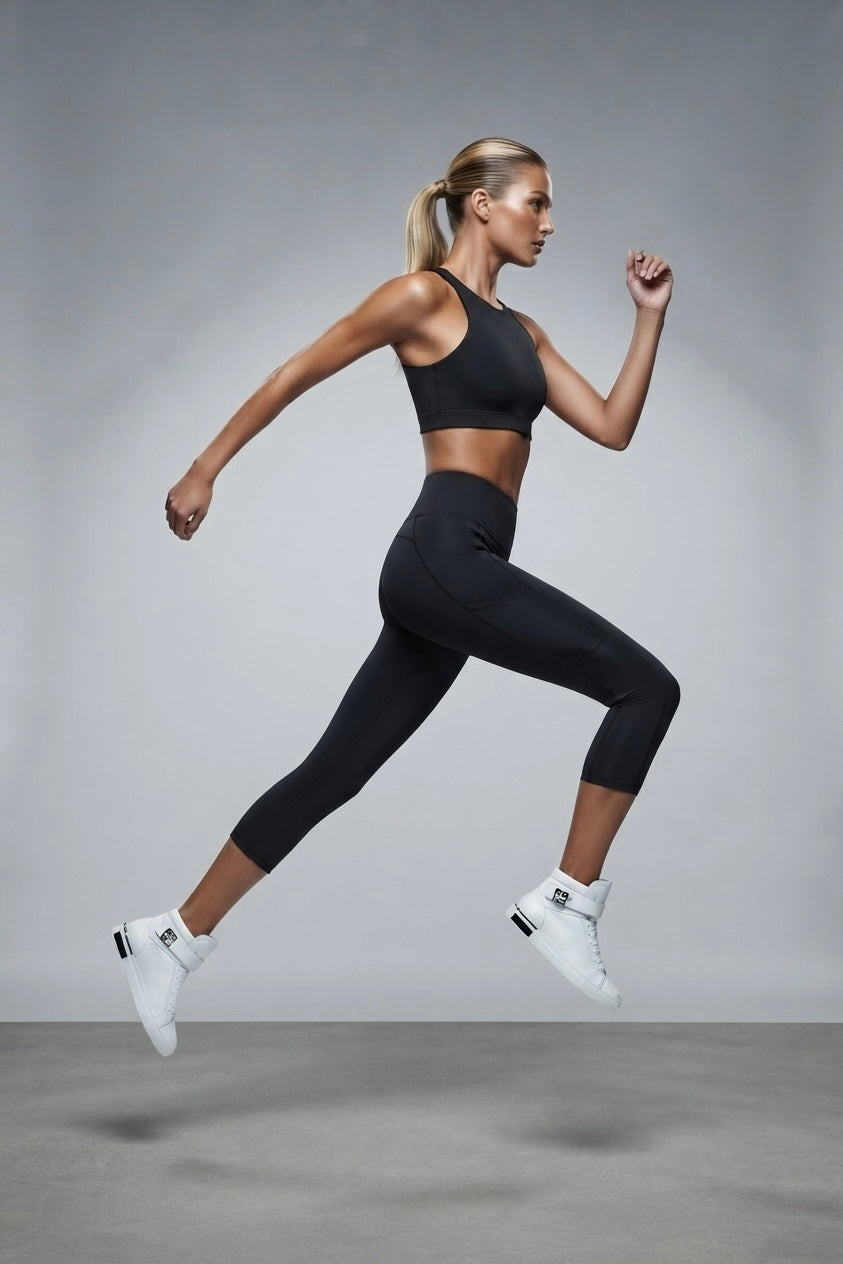
The Science of the Perfect Fit™
If you've ever pulled on a pair of leggings that looked amazing in the dressing room—but started sliding down halfway through your workout—you've experienced the difference between stretch and engineered compression.
They aren't the same thing.
In fact, one of the biggest misconceptions in athletic apparel is that any stretchy fabric qualifies as compression.
It doesn't.
Real compression is one of the most technically engineered fabrics in the apparel industry. Every pattern piece, seam placement, fabric direction, grading measurement, and panel shape must work together with the body's natural movement.
When even one of those elements is off by a fraction of an inch, you'll notice it immediately.
The waistband rolls.
The shorts ride up.
The sports bra digs into your shoulders.
The leggings sag after a few miles.
At SportPort Active, we spent years learning that true compression isn't about making garments tighter.
It's about making them smarter.

Stretch vs. Compression: They're Completely Different
One of the biggest myths in activewear is that if a garment stretches, it's compression.
Stretch simply means fabric can elongate.
Compression means the garment has been engineered to apply controlled pressure while maintaining complete freedom of movement.
Think of it like this.
Anyone can wrap a rubber band around a basketball.
That doesn't make it engineered.
The same principle applies to leggings.
Premium compression supports your muscles.
Improves stability.
Moves moisture efficiently.
Maintains consistent recovery after thousands of stretches.
Cheap stretch fabric simply gets longer.
Eventually...
It stays longer.

Why Compression Is Actually an Engineering Problem
Creating true compression requires balancing dozens of variables simultaneously.
Designers must consider:
- Muscle movement
- Joint articulation
- Body curvature
- Fabric recovery
- Stretch direction
- Seam placement
- Panel construction
- Compression pressure
- Heat management
- Moisture transport
This isn't fashion.
It's biomechanics.

Sports medicine researchers have long studied graduated compression because properly engineered compression may help reduce muscle oscillation during exercise and can enhance comfort and proprioception during movement. Results vary by athlete and activity, but consistent compression design is recognized as an important part of performance apparel.

Women's Bodies Were Never Meant to Fit Into Straight Lines
For decades, the fashion industry has tried to solve one of its most complicated challenges: how do you create clothing for millions of women when no two bodies are exactly alike?
The answer has always been more complex than simply creating smaller and larger versions of the same pattern.
Women’s bodies are not built like mathematical formulas. They are three-dimensional, constantly changing, and beautifully diverse.
Yet traditional apparel sizing has often attempted to reduce the human body into a simple sequence of numbers: XS, S, M, L, XL—or sizes 2 through 18.
The problem?
A woman is not a collection of straight measurements.
She is a combination of curves, proportions, movement patterns, muscle composition, height, posture, and personal anatomy.
Consider two women who both wear the same numerical size.
One woman may have:
- A smaller bust with wider hips
- Longer legs with a shorter torso
- Narrow shoulders with fuller thighs
- A straighter waist-to-hip ratio
Another woman may have:
- A fuller bust with narrower hips
- Broader shoulders
- A longer torso
- More athletic muscle development through the legs and glutes
Both women may measure similarly in one area, yet require completely different garment construction to achieve the same comfortable fit.
The human body does not follow a standardized template.
Apparel researchers have long recognized that accurate clothing fit depends on understanding multiple body dimensions, body shapes, and proportions—not just one or two measurements.
Anthropometric studies have shown that creating effective sizing systems requires analyzing a wide range of measurements because an “average body” does not accurately represent the diversity of real people.
This is why a woman can sometimes wear a size small in one activewear brand and a medium or large in another. The label does not tell the entire story because the pattern behind the garment may have been created around a completely different fit model.
Clothing sizes are not universal measurements; manufacturers often develop their own sizing systems based on their target customer and design philosophy.
The challenge becomes even greater when designing performance clothing.
Compression Clothing Creates an Even Greater Fit Challenge
Traditional clothing can sometimes tolerate small differences in fit.
A loose sweater can drape.
A relaxed blouse can accommodate movement.
A flowing dress can skim the body.
Compression apparel is different.
Compression garments are engineered to interact directly with the body. They must balance:
- Support
- Mobility
- Muscle movement
- Comfort
- Breathability
- Recovery
- Shape retention
A compression legging is not simply fabric sewn into a tube.

It must understand the architecture of the female body.
The waistband must support without digging.
The hip area must allow natural movement.
The thigh area must provide compression without restricting mobility.
The fabric must stretch in multiple directions while returning to its original shape.
The seams must follow the body’s movement rather than fight against it.
When a garment relies only on generic sizing, it can create problems:
- Too tight in one area.
- Too loose in another.
- Compression in the wrong places.
- Fabric pulling where the body naturally curves.
For active women, poor fit does not just affect appearance—it affects performance, confidence, and comfort.
Why Traditional XS Through XL Sizing Has Limitations
The idea behind standard sizing was efficiency. Manufacturers needed a way to produce clothing at scale. Instead of creating every garment individually, companies developed size ranges designed around population averages.
However, averages can be misleading.
An average does not represent every person inside that population.
It represents a mathematical midpoint.

Research in apparel design has repeatedly shown that body measurement databases and improved sizing systems are necessary because traditional size charts often struggle to represent diverse body shapes.
This is especially important for women’s activewear because women are not simply standing still inside their clothing.
They are moving.
They are stretching.
They are running.
They are lifting.
They are practicing yoga.
They are living active lifestyles.
A garment designed for movement must respect the body’s natural mechanics.
Women's Activewear Designed Around the Body, Not Against It
The future of premium activewear is moving away from the idea that women should adapt themselves to clothing.
Instead, clothing should adapt to women.
This means designing with:
- Real body measurements
- Advanced fabric technology
- Strategic pattern placement
- Multiple fit considerations
- Functional construction
Modern technologies such as 3D body scanning and digital measurement systems are helping apparel designers better understand body diversity and develop more personalized fits.
But technology alone is not the answer.
Great fit still requires craftsmanship.
It requires understanding how fabric behaves.
It requires understanding how women move.
It requires respecting the differences that make every body unique.
Why Most Brands Use Two-Inch Grading
Every garment begins as a single master pattern.
From there, manufacturers "grade" the pattern into additional sizes.
Most athletic brands increase each size by approximately two inches across the bust, waist, and hips.
For manufacturers...
It's fast.
Efficient.
Affordable.
For athletes...
It creates enormous jumps between sizes.
Many women discover one size feels restrictive while the next feels noticeably loose.
When compression fabric is involved, that two-inch jump becomes even more obvious.

Why SportPort Chose One-Inch Grading Instead
When I founded SportPort Active in 2011, I wasn't interested in simply following industry standards because they had always been done that way.
I wanted to understand why they existed in the first place—and whether they truly served the women who would wear our garments.
After studying apparel construction, pattern engineering, and compression fabrics, one thing became increasingly clear:
Women's bodies don't change in two inch increments.
Yet for decades, much of the apparel industry had relied on grading systems that increased garment dimensions by approximately two inches between sizes.
From a manufacturing perspective, it made perfect sense. Fewer sizes meant fewer paper patterns to create, fewer samples to sew, less inventory to manage, and a faster, more cost-effective production process. But what benefits the factory doesn't always benefit the woman wearing the garment.
Compression apparel presents an even greater challenge than everyday clothing because it isn't designed simply to fit the body—it must actively support it.
A compression garment needs to apply balanced, consistent pressure across muscles and joints while still allowing complete freedom of movement. Even small changes in circumference can noticeably alter how that compression feels during activity.
For many women, a two-inch jump between sizes creates an all-too-familiar experience.
One size feels slightly too restrictive through the hips or bust.
The next size suddenly feels looser through the waist or shoulders.
Instead of the garment adapting to the body, the woman is forced to choose which compromise she can live with.
We believed there had to be a better way.
Rather than accepting the industry's standard grading practices, SportPort Active adopted a one-inch grading system, reducing the size difference between garments by half.
At first glance, reducing the grading interval by just one inch doesn't sound particularly dramatic.
But in garment engineering, an inch can completely change how a performance garment behaves.
That additional level of precision allows every size to transition more gradually, enabling compression to remain balanced as the body naturally changes from one size to the next.
Instead of creating larger jumps in fit, every garment follows a smoother progression, contouring more naturally across the shoulders, bust, waist, hips, and legs.
For women whose measurements fall between traditional sizes—and that's far more common than many people realize—those smaller grading increments often become the difference between a garment that constantly needs adjustment and one that feels almost custom made.
The waistband stays comfortably in place.
The compression feels supportive rather than restrictive.
The sports bra distributes support more evenly across the shoulders and rib cage.
Leggings contour the body without creating unnecessary pressure points or loose areas.
The garment moves with the athlete instead of fighting against her.

Borrowing from Couture, Not Fast Fashion
Most people associate the word couture with Paris fashion houses, handcrafted evening gowns, and luxury designer collections.
Few realize that the same principles responsible for creating beautifully tailored couture garments can also produce extraordinary athletic apparel.
At SportPort Active, we've always believed that exceptional performance begins with exceptional fit. That philosophy led us to borrow many of the same methods traditionally reserved for couture fashion, where every curve, seam, and proportion is thoughtfully engineered long before a garment ever reaches production.
Unlike mass-produced apparel, where patterns are often created digitally and quickly scaled into multiple sizes, every SportPort design begins much more intentionally.
Every curve is carefully evaluated.
Every seam is placed with purpose.
Every panel is designed around how a woman's body actually bends, twists, stretches, reaches, and moves—not simply how it appears while standing still.

Our garments are engineered for movement first.
The aesthetic naturally follows.
This process takes considerably more time than conventional athletic apparel development.
It requires additional fittings.
Additional pattern revisions.
Additional sample garments.
Additional testing.
It's unquestionably more expensive.
But we've never believed premium performance apparel should be built around the fastest production schedule.
It should be built around the woman wearing it.
Why Paper Patterns Still Matter
One of the questions we're often asked is whether we still use traditional paper patterns.
The answer is an enthusiastic yes.
In today's apparel industry, most garments begin and end on a computer screen.
Sophisticated CAD (Computer-Aided Design) software allows manufacturers to scale patterns rapidly and send digital files directly to production facilities around the world.
There's no question these systems are efficient.
But efficiency isn't always the same as precision.
At SportPort Active, every original design begins the traditional way—with expertly drafted paper patterns.

Our experienced pattern makers shape, refine, and perfect every line by hand before the design is ever digitized for manufacturing.
Working with physical patterns allows them to study proportions in ways software simply cannot replicate. Tiny adjustments—sometimes measuring only fractions of an inch—can dramatically improve how a garment fits around the shoulders, bust, waist, hips, or legs.
From there, those patterns are draped and evaluated on professional dress forms and mannequins before moving to fit sessions with real athletes.
Every stage allows our designers to see how the garment behaves in three dimensions, revealing subtle refinements that would otherwise go unnoticed on a computer monitor.
This "old-school" craftsmanship has become increasingly rare in today's apparel industry because it requires something many manufacturers are unwilling to invest:
Time.
Patience.
Experience.
And a relentless commitment to getting every detail right.
To us, however, it's one of the defining reasons SportPort garments feel different the moment you put them on.
It's the difference between simply manufacturing activewear...
…and engineering a garment that feels like it was designed specifically for you.
Compression Must Move With the Body
One of the biggest differences between everyday apparel and performance apparel is that performance clothing isn't designed to stand still.
A woman might squat hundreds of times during a workout.
Reach overhead dozens of times in a yoga class.
Twist through a tennis serve.
Lean forward on a bicycle.
Hike uneven trails.
Paddle across open water.
Or spend an afternoon chasing children through the park.
Every one of those movements places different demands on a garment.
The fabric stretches.
Compression changes.
Seams shift.
Gravity pulls.
Muscles expand and contract.
If a garment has only been evaluated while standing on a fit model, there's no way to predict how it will perform once the body begins moving.
That's why true performance apparel must be engineered in motion—not just in front of a mirror.
We're of the belief that movement is pivotal throughout the development process.

Our garments are evaluated through real-world athletic positions to observe how compression, seams, waistbands, and support systems behave during activity—not simply how they look while standing still.
The goal is consistency.
Waistbands should stay comfortably in place instead of rolling or slipping.
Sports bras should continue providing balanced support through changing ranges of motion.
Compression should remain even across the body instead of becoming restrictive in one area while loosening in another.
Every seam should stay where it was intentionally placed.
When engineering comes before aesthetics, movement feels effortless and natural.
And when beautiful design is combined with thoughtful engineering, women no longer have to choose between performance and style.
At SportPort Active, we've always believed they should have both.

The Hidden Cost of Better Fit
When shoppers compare two pairs of leggings or two sports bras, it's easy to assume they're similar products with different price tags.
In reality, much of what determines quality is completely invisible.
It exists long before the first garment reaches a store.
Long before fabric is cut.
Long before a single stitch is sewn.
Premium activewear requires hundreds of decisions that consumers never see.
Selecting high-performance yarns that maintain compression over time.
Choosing premium elastane with excellent stretch recovery.
Developing original patterns instead of modifying existing ones.
Creating multiple rounds of prototype garments.
Conducting repeated fit sessions with real athletes.

Revising patterns after every evaluation.
Testing garments during movement rather than relying solely on static fittings.

Refining compression zones until support feels balanced across the body.
Inspecting construction to ensure every seam performs exactly as intended.
Each of those steps adds time.
Each requires specialized knowledge.
And each contributes to the way a garment performs years after it leaves the factory.
It's one of the reasons premium athletic apparel costs more to develop than garments designed primarily for speed and volume.
At SportPort Active, we've never viewed those additional steps as unnecessary expenses.
We see them as investments in the woman who will wear the garment. Because exceptional fit isn't created by accident.
It's the result of countless small decisions made long before the first customer ever tries it on.
The Science Is Only Half the Story
By now, it's easy to see why creating exceptional athletic apparel is far more complex than simply choosing a fabric and sewing it together.
Behind every sports bra, pair of leggings, or performance top lies a remarkable blend of biomechanics, textile science, pattern engineering, garment construction, and decades of craftsmanship.
Every decision—from the way a pattern is graded to the placement of a single seam—can influence how a garment performs, how long it lasts, and ultimately how confident a woman feels wearing it.
Unfortunately, much of today's apparel industry has been driven by speed. Digital automation, mass production, and aggressive manufacturing schedules have made clothing more accessible than ever before, but they've also moved many brands further away from the meticulous craftsmanship that once defined exceptional fit.
Yet some companies continue to believe there's a better way.
They believe athletic apparel should be engineered around women—not the other way around.
They believe every pattern deserves careful refinement.
They believe compression should support movement, not restrict it.
And they believe precision is worth the extra time.
Those beliefs became the foundation upon which SportPort Active was built.

Coming Up in Part 3
Understanding the science behind garment engineering is only part of the story.
The next question is even more fascinating:
How do you actually build premium activewear that lives up to those principles?
In Part 3, we'll step behind the scenes at SportPort Active to explore how couture-inspired craftsmanship, one-inch grading, traditional paper pattern making, athlete wear testing, premium materials, and years of refinement come together to create garments designed for the way women truly move.
Because exceptional fit doesn't happen by chance.
It's engineered—one pattern, one seam, and one thoughtful decision at a time.
Read more

How the Industrial Revolution Changed Clothing Forever—and Why Finding the Perfect Fit Still Feels Impossible Today
Discover how SportPort Active combines couture paper patterns, one-inch grading, premium compression engineering, and years of athlete testing to create activewear that fits beautifully, performs f...