


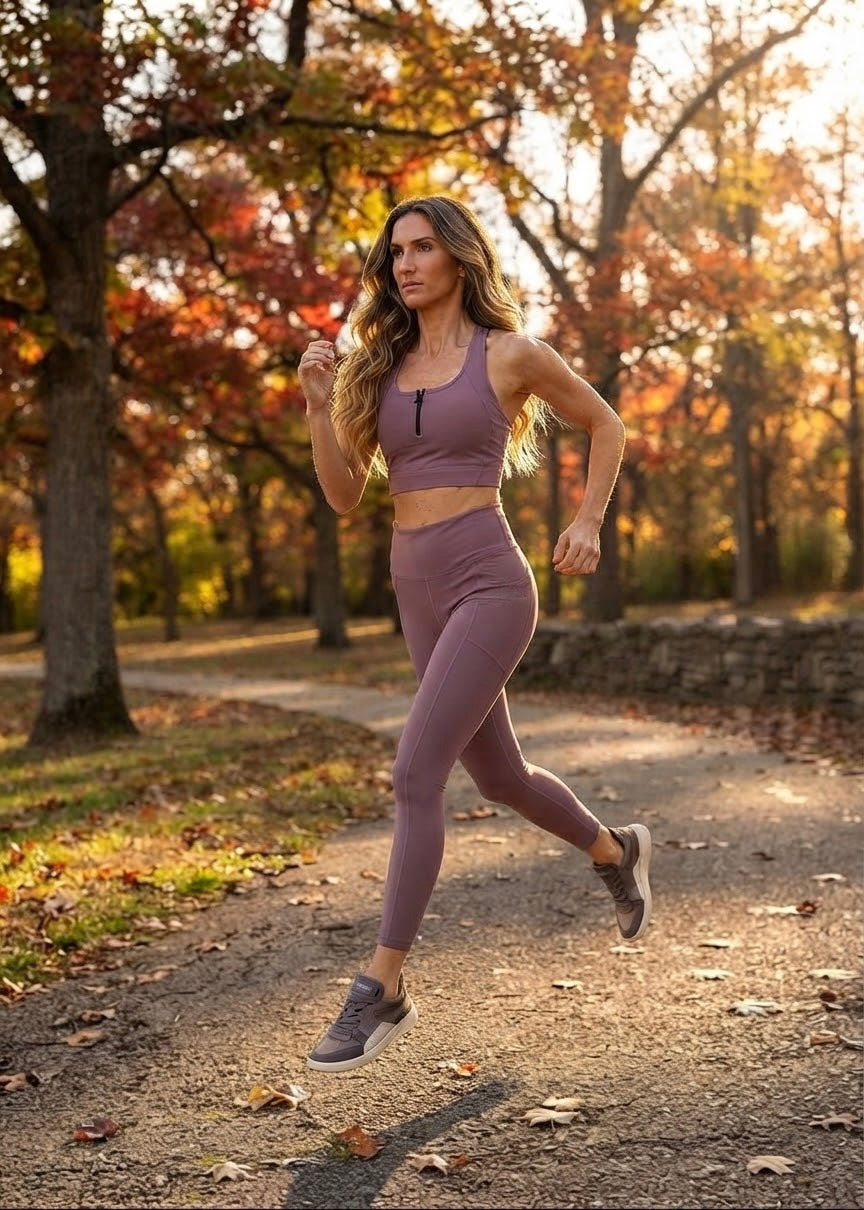
Fall Fitness Test for Women: 5 Benchmarks to Track in 6 Weeks
What If October Were Your New January?
January has excellent public relations.
Every year it arrives with new workout plans, new goals, new gym memberships and an almost unreasonable amount of enthusiasm for reorganizing one's entire life.
October gets pumpkins.
We think October deserves more.
In fact, fall may be one of the best times of year to take an honest look at your fitness.
Summer has ended. Your normal schedule is back. You probably have a pretty good idea of what you've been doing all year—running, riding, golfing, playing tennis, lifting, practicing yoga, hiking, swimming, walking or perhaps a slightly chaotic combination of all of them.
And winter is coming.
Before shorter days, holiday schedules and cold weather start rearranging your routine, why not find out exactly where you stand?
Not on a scale.
We're talking about something much more interesting:
What can your body do today?
How efficiently can you cover a mile?
How many times can you stand from a chair in 30 seconds?
How confidently can you balance on one leg?
Are you actually getting stronger?
And when you look at an entire week—not merely your scheduled workouts—how much are you really moving?
That's the SportPort Autumn Baseline Challenge.
Take five simple measurements now.
Train for six weeks.
Then repeat them around Thanksgiving.
No transformation photos.
No crash diet.
No arbitrary goal weight.
Just one question:
Did I become more capable?
Why Measure Fitness in the First Place?
We track nearly everything now.
Steps.
Sleep.
Heart rate.
Running pace.
Cycling power.
Calories.
Recovery scores.
Yet many women still evaluate an entire season of exercise with one number:
Body weight.
That's a remarkably incomplete measurement.
Your weight can remain almost unchanged while your cardiovascular fitness improves, your legs become stronger, your balance improves and an activity that once exhausted you starts feeling easy.
Recent female-specific research reinforces how trainable women remain throughout adulthood. A 2026 systematic review and meta-analysis examined 126 studies involving 4,019 women and found significant improvements in muscular strength in both premenopausal and postmenopausal women following resistance training. The researchers emphasized individualization rather than assuming women should train according to rigid age-based rules.
In other words, improvement is available.
But if you never measure anything meaningful, you may not notice it.
That's where a baseline becomes valuable.
It turns:
"I think I'm fitter."
into:
"That mile is 52 seconds faster at the same effort."
Or:
"I'm lifting a heavier dumbbell."
Or:
"The side that used to wobble after nine seconds now feels controlled for twenty."
Those are results.
The Woman Who Changed How We Think About Measuring Activity
There's another reason we like this approach.
Dr. Barbara Ainsworth, Regents Professor Emerita at Arizona State University, has spent much of her career studying something deceptively complicated:
How do we accurately measure physical activity?
Her areas of expertise include physical-activity epidemiology, physical-activity surveillance, environmental influences on activity and specifically physical activity in women. She is also lead author of the Adult Compendium of Physical Activities, the widely used reference that standardizes the energy costs of hundreds of different activities.
Her work is a good reminder that an active life is bigger than the workout we remembered to log.
Women may run.
But we also walk dogs.
Carry groceries.
Garden.
Ride horses.
Walk golf courses.
Move through airports.
Clean.
Hike.
Play with children.
Do yard work.
Take stairs.
Spend an afternoon on our feet at a tournament or horse show.
Some of those activities are exercise.
Some are simply life.
They still contribute to the total picture.
So our first test doesn't happen in a gym at all.
It happens on your calendar.
Fitness Number 1: Your Seven-Day Movement Map

For seven days, pay attention to how your body actually spends its time.
Count the deliberate exercise, certainly.
Record the tennis match.
The run.
The strength session.
The Pilates class.
The trail ride.
But also notice meaningful movement outside your official workouts.
A 40-minute dog walk matters.
Walking 18 holes matters.
Three hours of barn work matters.
A long hike matters.
The objective isn't to inflate your exercise total.
It's to see your real pattern.
Current public-health guidance recommends adults accumulate at least 150 minutes of moderate-intensity aerobic activity weekly, or an equivalent combination of vigorous activity, along with muscle-strengthening work on at least two days. But the broader message is equally useful: some activity is better than none, and movement can be accumulated throughout the week.
At the end of seven days, don't simply total the minutes.
Look at the shape of your week.
Perhaps you move constantly but never strength train.
Perhaps you lift four days but spend the rest of your waking hours sitting.
Maybe you're incredibly active Saturday and Sunday and barely move Monday through Friday.
Maybe tennis is providing nearly all your cardio.
Maybe the dog is responsible for most of your weekly walking.
That's useful information.
You're not giving yourself a grade.
You're discovering your pattern.
Fitness Number 2: Your One-Mile Efficiency Test

Now we're going outside.
Choose a flat, safe one-mile route you can repeat six weeks from now.
Walk briskly rather than jogging.
Record two things:
Your finishing time and how hard the effort felt on a scale of 1–10.
For example:
October baseline: 16:02 — effort 7/10
Six weeks later: 15:14 — effort 6/10
That tells a much richer story than speed alone.
You covered the mile faster and perceived it as easier.
Variations of the one-mile walking test have been used in exercise science to estimate cardiorespiratory fitness. One validation study involving 304 healthy men and women ages 40–79 developed a treadmill-based one-mile walking model for estimating peak oxygen uptake.
We're not suggesting you turn the backyard into an exercise physiology laboratory.
For this challenge, the value is much simpler.
Use yourself as the reference.
Same route.
Similar conditions.
Same walking—not running—method.
Then compare October you with November you.
That's the only competition that matters.
Why a Mile Tells You More Than You Think

Cardiovascular fitness shows up everywhere.
Not only during running.
It helps you walk a hilly golf course.
Recover between tennis points.
Hike without stopping every five minutes.
Spend a long day at the barn.
Travel.
Cycle.
Swim.
Keep up with your family.
Walk up a long staircase and continue talking afterward instead of pretending you suddenly became fascinated by the wall.
That is why we like the mile.
It's ordinary enough to be relevant.
And measurable enough to show change.
Fitness Number 3: The 30-Second Chair Stand
Now find a stable chair without wheels.
Using the same chair for both tests is important.
Sit with your feet securely planted. If you're comfortable and able to do so safely, keep your arms crossed over your chest.
Set a timer for 30 seconds.
Stand fully.
Sit back down with control.
Repeat.
Record the number of complete repetitions.
The chair stand looks almost comically simple until about second 22.
Then your quadriceps begin submitting formal complaints.
The test has a long history in functional assessment. Research found the 30-second chair stand to have good test-retest reliability and a meaningful relationship with lower-body strength.
We're adapting the idea here as a personal benchmark rather than a clinical test.
Maybe your baseline is 15 repetitions.
Six weeks later it is 18.
Maybe the number only increases by one—but the movement feels more controlled.
That's still information.
Why Chair Strength Matters to Athletic Women

You may be thinking:
"I play tennis. Why am I getting up from a chair?"
Because the underlying movement is everywhere.
Producing force through your hips and legs helps you:
Climb.
Hike.
Run.
Ride.
Ski.
Golf.
Lunge.
Lift.
Get off the floor.
Carry something upstairs.
And yes, eventually stand from chairs.
Functional strength isn't the opposite of athletic strength.
It is the foundation underneath it.
Fitness Number 4: The One-Leg Reality Check

Stand beside a kitchen counter or another stable support.
Keep your eyes open.
Lift one foot.
Start the timer.
Stop at 30 seconds or when you need to put the foot down.
Then test the other side.
We're especially interested in the difference between the two sides.
Maybe your right leg feels rock solid for 30 seconds while the left becomes shaky at 14.
That's useful.
Don't turn this into an acrobatics competition by closing your eyes or standing on a cushion.
The objective is a repeatable baseline.
Single-leg stance is used in balance assessment, and research continues to support the reliability of single-leg balance measurements under standardized conditions. A recent study in healthy adults found particularly good-to-excellent reliability for several single-leg postural-control measures across repeat testing.
For our purposes, however, you don't need laboratory equipment.
Ask:
Can I control the position?
Do the two sides feel similar?
Then see what changes after six weeks.
Balance Isn't Just for Yoga

Consider how many sports are secretly single-leg sports.
Running?
One foot at a time.
Tennis?
Constant reaching and recovering.
Pickleball?
Same.
Golf?
Weight shifts between sides throughout the swing.
Hiking?
One foot repeatedly accepts your body weight on uneven terrain.
Horseback riding?
Continuous balance adjustments occur while the surface beneath you is quite literally alive.
Better balance does not automatically make you brilliant at all of those sports.
But body control is an athletic quality worth maintaining.
Especially as we want to remain active for decades.
Fitness Number 5: Your Strength Anchor

Here's where we deliberately refuse to give every woman the same test.
Choose one resistance exercise you already know how to perform safely.
That becomes your Strength Anchor for the next six weeks.
It might be a goblet squat.
A dumbbell row.
A chest press.
A leg press.
A Romanian deadlift.
A push-up variation.
A cable row.
An experienced lifter might use a familiar barbell exercise.
The exact exercise isn't the story.
Repeatability is.
Write down:
The weight.
The repetitions.
And roughly how difficult the set felt.
Imagine your October baseline is:
25-pound goblet squat × 8 repetitions — effort 8/10.
Six weeks later:
30 pounds × 8 repetitions — effort 8/10.
Progress.
Or perhaps:
25 pounds × 11 repetitions — effort 8/10.
Also progress.
Or:
25 pounds × 8 repetitions — now effort 6/10.
Still progress.
Your body became better at producing the same work.
Women Should Know Their Strength Number

This may be the most important measurement in the entire dashboard.
Not because every woman needs to become obsessed with lifting heavier weights.
Because strength is physical capacity.
The new 2026 National Strength and Conditioning Association position statement on female athletes emphasizes that while women have physiological considerations that deserve appropriate attention, the fundamental principles of strength and conditioning still apply—including progressive overload.
And the large 2026 female resistance-training meta-analysis gives women another reason to be optimistic: meaningful strength improvements were seen across both pre- and postmenopausal groups.
That's worth remembering when fitness culture starts implying that turning 40 requires surrendering your ambition and buying very tiny dumbbells.
It doesn't.
Train appropriately.
Progress gradually.
And give yourself something meaningful to measure.
Your Five-Part Fall Fitness Dashboard
| Check | What You're Measuring | October Baseline | Six-Week Retest |
|---|---|---|---|
| 7-Day Movement Map | Consistency + variety | ___ active min / ___ strength days | ___ |
| 1-Mile Walk | Aerobic efficiency | ___ min / effort ___ of 10 | ___ |
| 30-Second Chair Stand | Lower-body functional strength | ___ reps | ___ |
| Single-Leg Balance | Control + left/right symmetry | L ___ sec / R ___ sec | ___ |
| Strength Anchor | Progressive strength | ___ lb × ___ reps / effort ___ | ___ |
That's the dashboard.
Notice what's missing?
BMI.
Body-fat percentage.
Before-and-after photographs.
The scale.
This challenge is about performance.
Now Comes the Six-Week Autumn Experiment

Here's where most fitness challenges go wrong.
They suddenly demand that you change everything.
New diet.
New workouts.
New morning routine.
New supplements.
New personality.
We're not doing that.
For six weeks, continue living your active life.
Run.
Ride.
Golf.
Swim.
Play tennis.
Walk.
Practice yoga.
Take your strength classes.
Hike.
Do whatever movement already belongs to you.
Then identify one or two dashboard numbers you'd most like to improve.
If your cardiovascular benchmark surprised you, add purposeful aerobic movement.
If your lower-body strength needs attention, make resistance training more consistent.
If your left-right balance is noticeably different, include appropriate single-leg work in your regular program.
If you're already very active but the movement map reveals zero strength training, there's your opportunity.
You don't have to overhaul your life.
You need a target.
Don't Retest Every Tuesday
This is important.
Once people have a number, we immediately want to test it again.
And again.
And again.
Resist.
Testing isn't training.
Imagine planting something and digging it up every four days to inspect the roots.
Nothing good is happening there.
Instead:
Establish the baseline.
Train.
Recover.
Repeat consistently.
Then come back six weeks later.
Progress often becomes much easier to see when you give it enough time to occur.
The Thanksgiving Retest

Thanksgiving gives this challenge a wonderfully natural finish line.
Not because anyone needs to earn Thanksgiving dinner.
You do not.
Thanksgiving simply arrives roughly six weeks after an early-October baseline.
That's perfect.
Before the holiday gets underway, repeat the five checks under conditions as similar as reasonably possible.
Use the same mile route.
The same chair.
The same balance setup.
The same strength exercise.
And preferably the same method for your seven-day activity snapshot.
Then compare.
Maybe your mile improved by 45 seconds.
Maybe you added two chair stands.
Maybe your weaker leg gained nine seconds of controlled balance.
Maybe you're lifting five pounds more.
Perhaps the biggest result is that the movement map shows you stayed consistently active while daylight shortened and your schedule became busier.
That counts.
Maintenance is sometimes an achievement too.
You Don't Need to Improve All Five Numbers
This may be the most important rule.
Fitness isn't a video game where every stat must increase simultaneously.
Imagine a runner training for a race.
Her mile efficiency may improve significantly while her strength benchmark simply holds steady.
Fine.
A woman emphasizing strength may dramatically improve her lifting number while her one-mile walk barely changes.
Also fine.
An equestrian may work specifically on unilateral strength and balance.
A golfer may prioritize strength.
A tennis player may prioritize conditioning.
Your dashboard is not a report card.
It is a conversation with your body.
Your Sport May Reveal Your Strongest Number—and Your Weakest
This is where the experiment becomes especially interesting for active women.
Every sport develops something.
And every sport leaves something behind.
A marathoner may crush the walking test but discover she hasn't meaningfully strength trained in months.
An equestrian may demonstrate wonderful balance but want more measurable lower-body strength.
A golfer may have excellent coordination while aerobic conditioning deserves attention.
A yogi may own the balance test but decide progressive resistance is the missing piece.
A tennis or pickleball player may have substantial weekly movement but very little structured strength work.
A lifter may have an impressive Strength Anchor while realizing her weekly aerobic movement has quietly disappeared.
None of those observations means you're training incorrectly.
They show you where your favorite activity has made you strong—and where something complementary might make you more complete.
The Scale Could Stay Exactly the Same
Imagine finishing your six weeks with these results:
Your mile is faster.
You perform four more chair stands.
Your weaker-side balance has improved.
You lift a heavier dumbbell.
Your weekly movement is more consistent.
And your body weight?
Exactly the same.
Did nothing happen?
Of course something happened.
This is why reducing fitness to weight can become so misleading.
A scale measures mass.
It cannot measure:
Endurance.
Strength.
Balance.
Coordination.
Movement confidence.
Exercise consistency.
The ease with which you climb stairs.
Or the moment you realize something that felt hard in October no longer feels particularly hard in November.
Your dashboard can.
Why This Matters More in Your 30s, 40s and 50s
At some point, fitness begins becoming less about proving what your body looks like and more about protecting what your body lets you do.
Can you still hike?
Ride?
Run?
Carry your suitcase?
Learn pickleball?
Ski?
Play tennis?
Walk all day through a new city?
Take up golf?
Lift weights?
Get up easily from the floor?
Say yes when someone suggests an adventure?
That's a very different definition of fitness.
And we think it's a better one.
Strength gives you options.
Endurance gives you range.
Balance gives you confidence.
Consistency helps preserve all three.
A Result Is More Motivating Than a Resolution
There's another reason we prefer this fall experiment to waiting for January.
Resolutions are promises about the future.
Baselines are information about the present.
You don't need to declare:
"This winter I'm going to get into the best shape of my life."
That's an enormous and fairly meaningless assignment.
Instead:
"I'm going to improve my one-mile time while keeping the effort comfortable."
Clear.
Or:
"I'm going to make two strength sessions happen every week."
Measurable.
Or:
"I'm going to improve the control on my weaker leg."
Useful.
Specific results give your workouts a job.
Keep the Tests Safe—and Keep Them in Perspective
These are informal personal fitness benchmarks, not medical diagnostic tests.
If you have a health condition affecting exercise, significant dizziness, unexplained chest symptoms, a recent injury or surgery, or you've been advised to restrict activity, talk with an appropriate healthcare professional before performing fitness tests or changing your program.
Stop any test that causes pain or unusual symptoms.
And remember:
The purpose isn't to discover whether you're "fit enough."
There is no SportPort score you need to pass.
The purpose is to establish your starting point.
This Fall, Compete With the Woman You Were Six Weeks Ago
Fitness culture gives us endless opportunities to compare ourselves.
Someone runs faster.
Someone lifts more.
Someone is younger.
Someone has been practicing yoga for fifteen years.
Someone on social media apparently wakes at 4:37 a.m., runs seven miles, lifts weights, makes organic muffins and answers seventeen emails before sunrise.
Good for her.
She isn't your baseline.
You are.
That's the beauty of this experiment.
No leaderboard.
No ranking.
No ideal number.
Just October you and Thanksgiving you.
At SportPort Active, we believe fitness should expand what women feel capable of doing.
That may mean crossing a marathon finish line.
It may mean riding stronger.
Improving your tennis game.
Hiking farther.
Adding weight to a squat.
Or simply discovering that the staircase that used to leave you breathless doesn't anymore.
Those changes deserve to be noticed.
So this October, before winter changes the rhythm of your routine, take the test.
Map your week.
Walk the mile.
Use the chair.
Check your balance.
Choose your strength anchor.
Write the numbers down.
Then stop testing and start living.
Train for six weeks.
Come back around Thanksgiving.
And instead of asking the question women have been encouraged to ask for far too long—
"What do I weigh?"
Ask the better one:
"What can I do now?"
Read more
Same speed. Same time. Different environment. A practical look at treadmill vs outdoor running, indoor vs outdoor cycling, calorie estimates, watts, cooling and winter training.

Frozen shoulder isn't a new wellness trend. Discover its history, why women over 40 are more susceptible, what researchers know about menopause, and when shoulder stiffness deserves medical attention.