



The Outdoor Class Multiplier: Why Taking Your Workout Outside May Give Your Brain & Body More
What If Your Workout Could Do More Than Work Your Muscles?
Picture two Tuesday mornings.
In the first, you drive to the gym, walk beneath fluorescent lights, find your place in a crowded studio, complete your workout, and drive home.
Good workout.
Mission accomplished.
Now picture the second.
You meet a group of women at a park.
The air is cool enough that you can feel it on your skin. The sun is beginning to come through the trees.
Someone is laughing about how much she dislikes walking lunges. Birds are making considerably more noise than necessary.
You squat.
Lunge.
Walk.
Stretch.
Breathe harder.
Talk to someone you haven't seen since last week's class.
Forty-five minutes later, you've exercised—but you've also been outside, exposed yourself to natural daylight, spent time around other people, and given your brain a temporary break from walls and screens.
Same 45 minutes.
Potentially a very different experience.
That combination is what we're calling the Outdoor Class Multiplier.
And science is beginning to suggest that the environment surrounding your workout may matter almost as much as we once assumed only the exercise itself did.

The Outdoor Class Multiplier: Four Benefits in One Hour
Outdoor fitness classes are interesting because they don't deliver just one wellness input.
They can give you four at once:
1. Movement
The cardiovascular, muscular, metabolic, balance, and mobility benefits of exercise.
2. Nature
Green space, open sky, trees, water, and a less visually demanding environment.
3. Daylight
Natural light that helps signal your internal circadian system.
4. Connection
The accountability, encouragement, humor, and familiarity of moving with other people.
None of these ingredients is magical by itself.
But stack them together?
Now we have something worth investigating.
And researchers are.
First: Yes, the Exercise Still Matters Most
Before we give the trees too much credit, let's establish the foundation.
You're still exercising.
Current CDC physical activity guidance for adults recommends at least 150 minutes of moderate-intensity aerobic activity each week, or 75 minutes of vigorous activity, along with muscle-strengthening exercise on at least two days.
An outdoor strength circuit, walking class, boot camp, yoga session, interval workout, or combination class can help contribute toward those goals, depending on intensity and programming.
Regular physical activity supports cardiovascular health, muscular strength, metabolic health, functional fitness, and mental well-being.
Moving the class outside doesn't replace any of that.
What it may do is add something.

Green Exercise: When Movement Meets Nature
Researchers use the term green exercise to describe physical activity performed in natural or green environments.
This field has grown considerably over the last decade.
And 2026 brought some particularly interesting findings.
A new systematic review and meta-analysis examining 51 studies found that green exercise was associated with improvements in well-being and positive affect and reductions in negative affect. The researchers also found favorable mental-health results when green exercise was compared with indoor exercise, although—as with most emerging areas of research—study designs varied and we shouldn't interpret nature as a treatment for mental illness.
Another 2026 analysis comparing green exercise, indoor exercise, and control groups similarly reported favorable mental-health outcomes for exercise performed in natural environments.
That doesn't mean your local park possesses mysterious healing powers.
It may mean the context of movement changes the psychological experience of movement.
That's much more interesting.

The Surprise Finding: Outside May Make Exercise More Enjoyable
This may be the most important piece of the puzzle.
Because the greatest workout in the world doesn't do much good if you dread it so much that you stop showing up.
A 2024 systematic review and meta-analysis comparing individual bouts of outdoor and indoor exercise found that outdoor exercise produced greater enjoyment. Interestingly, researchers did not find convincing evidence that exercising outside dramatically changed most physiological outcomes when exercise intensity was matched.
That distinction matters.
Outside isn't necessarily turning a squat into a physiologically superior squat.
It may be turning the experience into something you enjoy more.
And enjoyment is not trivial.
Enjoyable movement is easier to repeat.
Repeatable movement becomes a habit.
Habits create results.
Suddenly, the most important benefit of the outdoor class may not be what happens during one workout.
It may be that you're more willing to come back next Thursday.
Why This Could Matter Especially for Women
Here is where the research becomes particularly interesting for our SportPort community.
A 2025 systematic review and meta-analysis examined randomized trials of urban green exercise.
Researchers found a moderate positive effect on mental health and reported that the strongest effects tended to appear with relatively short, frequent, low-to-moderate intensity sessions.
They also observed greater benefits among female participants.
That doesn't establish a special universal prescription for women, and more research is needed.
But it raises a compelling question.
Could an outdoor walking group, park yoga class, or neighborhood strength session give busy women something that a traditional workout sometimes doesn't?
Exercise without another ceiling overhead.
A little less sensory clutter.
A little more sunlight.
A few people who notice when you don't show up.
And one hour when nobody needs anything from you except perhaps the instructor asking for ten more squats.
That last part is negotiable.
Your Brain Gets a Change of Scenery Too
Our bodies weren't the only thing spending the last several decades indoors.
Our brains came with us.
Work.
Email.
Phones.
Traffic.
Screens.
Artificial lighting.
Notifications.
Indoor environments demand continual directed attention.
Outdoor natural environments provide a different visual and sensory experience.
Movement through green space introduces changing light, depth, vegetation, sounds, wind, temperature, and visual distance.
Instead of staring at a wall six feet away, your eyes may scan trees fifty yards away.
Instead of a television mounted above a treadmill, there is an actual horizon.
Research comparing physical activity in natural versus urban outdoor environments has found favorable effects for outcomes including anxiety, fatigue, positive affect, and vigor, although researchers have also pointed to variability and methodological limitations in the evidence.
In other words:
You don't have to decide that nature is medicine.
You can simply recognize that your brain notices where you are.

Morning Class? You May Be Stacking Another Benefit
Now let's bring in neuroscientist Dr. Andrew Huberman, professor at Stanford School of Medicine and host of the Huberman Lab podcast.
One of Huberman's most repeated recommendations involves getting outdoor light relatively soon after waking to help anchor circadian rhythms and support daytime alertness and nighttime sleep.
His current Huberman Lab Daily Blueprint recommends prioritizing outdoor morning light, and he often suggests combining morning light with movement when practical.
This doesn't mean you need to perform burpees while staring toward the sunrise.
Please don't stare directly at the sun.
But an early outdoor fitness class naturally combines two things many people struggle to fit into their mornings:
movement + daylight.
That's efficient wellness.
And for a woman trying to get children out the door, answer work emails, remember everyone's appointments, and somehow take care of herself too, efficient matters.
Then There Is the Group Effect
Why are fitness classes so different from exercising alone?
Because humans notice other humans.
You start recognizing faces.
Someone remembers your name.
Someone saves you a spot.
The instructor notices you got stronger.
The woman beside you laughs when both of you lose balance during the same exercise.
Eventually you're no longer attending a random class.
You're attending your class.
A 2026 systematic review examining adherence in adult group fitness found that attendance behavior appears to be influenced by factors including self-efficacy, social relationships, group identification, instructor behavior, and the motivational environment created within the class. The researchers also cautioned that findings were heterogeneous and much of the evidence remains observational.
That nuance is useful.
Simply putting twenty strangers on yoga mats doesn't automatically create community.
But the right instructor and repeated attendance can.
Familiarity develops.
Encouragement develops.
Accountability develops.
And somewhere along the way:
"I should exercise today" becomes:
"I'll see everyone at class."
That is a very different motivation.
Nature + People May Be the Real Secret Sauce
A particularly relevant 2026 review examined community-based green exercise—essentially movement conducted outdoors in a social or community setting.
Researchers analyzed 57 studies and found positive effects on mental well-being and physical-activity engagement. Their qualitative findings repeatedly highlighted the value of social opportunities, accessibility, fun, and variety in helping people participate and stick with programs.
Notice the words researchers keep returning to.
Not punishment.
Not guilt.
Not six-pack abs.
Fun.
Variety.
People.
Maybe wellness doesn't always need to be more complicated.
Maybe sometimes it needs to be more enjoyable.
Outdoor Fitness Doesn't Have to Mean Boot Camp
If you just pictured an instructor blowing a whistle while you drag a tractor tire through wet grass, we'd like to expand the definition.
An outdoor fitness class might be:
- Yoga in the park
- Pilates on a lawn
- Strength circuits
- Walking groups
- Run clubs
- Hiking groups
- Barre outdoors
- Mobility classes
- Bodyweight training
- Outdoor HIIT
- Beach workouts
- Paddleboard yoga
- Tennis conditioning
- Pickleball fitness
- Trail-based workouts
- Mom-and-daughter fitness groups
- Outdoor dance classes
The best format is the one that matches your personality and fitness level.
Love intensity?
Find a conditioning class.
Need restoration?
Try yoga outdoors.
Want fitness without feeling like you're "working out"?
Join a walking group.
Want community more than competition?
Find a recurring neighborhood class where people actually learn one another's names.
There is no prize for choosing the hardest option.
The goal is consistency.
The 20-Minute Finding We Didn't Expect
Here's another reason you don't need an epic two-hour park workout.
The 2025 urban green-exercise analysis found particularly favorable mental-health effects in interventions using shorter sessions—20 minutes or less—performed relatively frequently at low-to-moderate intensity.
This does not mean 20 minutes is universally optimal.
But it does reinforce something important:
Your outdoor movement does not have to consume the day.
Twenty minutes before work.
Thirty minutes after school drop-off.
A lunchtime walking group.
A short strength circuit at the park.
For busy women, the workout that fits may beat the perfect workout that never happens.
Why Outdoor Classes Can Feel Harder—and Sometimes Easier
Outside, the environment isn't perfectly controlled.
Wind changes.
Temperature changes.
Grass isn't quite level.
Sand shifts.
Hills exist.
The ground may require slightly more attention than a perfectly flat studio floor.
Depending on the class, that variety can challenge coordination and body awareness.
But the environment can also make the experience feel psychologically easier because attention isn't focused exclusively on exercise.
You're noticing the sky.
The breeze.
Other people.
Dogs behaving badly nearby.
You may still be working hard—but you aren't staring at a clock waiting for class to end.
This may help explain why research repeatedly finds enjoyment as one of outdoor exercise's most consistent advantages.
The Outside Advantage Is Not "More Calories"
We want to make this distinction because wellness marketing loves making everything about calorie burn.
Outdoor fitness classes are not valuable because trees somehow cause you to burn dramatically more calories.
They are valuable because they may improve the experience surrounding exercise.
You can strengthen muscles inside.
You can elevate your heart rate inside.
You can absolutely become incredibly fit inside.
The outside advantage may live somewhere else:
Mood.
Enjoyment.
Daylight.
Attention.
Community.
Novelty.
Motivation.
Adherence.
And those things matter because fitness is a long game.

Try the SportPort Outdoor Class Experiment
Rather than reading another wellness article and thinking that sounds nice, try it.
For the next four weeks, replace one indoor workout each week with an outdoor group activity.
That's it.
Don't change your entire routine.
Run an experiment.
Week 1: Go Green
Take yoga, strength, Pilates, or a walking class in a park.
Afterward, ask yourself:
Did I enjoy this more, less, or about the same as my usual indoor workout?
Week 2: Go Social
Return to the same class.
Introduce yourself to one person.
You now know someone.
Week 3: Go Early
If your schedule allows, try a morning outdoor session and get natural daylight while you move.
See how you feel during the morning and later that evening.
Week 4: Decide
Ask:
Did I look forward to this workout?
Did I feel mentally different afterward?
Did the group make me more likely to attend?
Would I voluntarily do this again?
If yes...
Keep it.
That's the result that matters.

Outdoor Class Safety: Nature Still Has Weather
Working out outside requires a little common sense.
Heat and humidity affect exercise differently than climate-controlled air.
The American College of Sports Medicine's guidance on exercising in hot and cold environments recommends reducing intensity and duration when suddenly exercising in hotter conditions, staying attentive to hydration, and choosing cooler times of day when heat risk rises.
Sun protection matters too.
The American Academy of Dermatology recommends broad-spectrum, water-resistant sunscreen with SPF 30 or higher, along with shade and sun-protective clothing when appropriate.
Bring water.
Dress in breathable layers.
Check the weather.
Modify when needed.
And remember:
Moving class indoors because it's 95 degrees with crushing humidity does not make you less committed.
It makes you sensible.

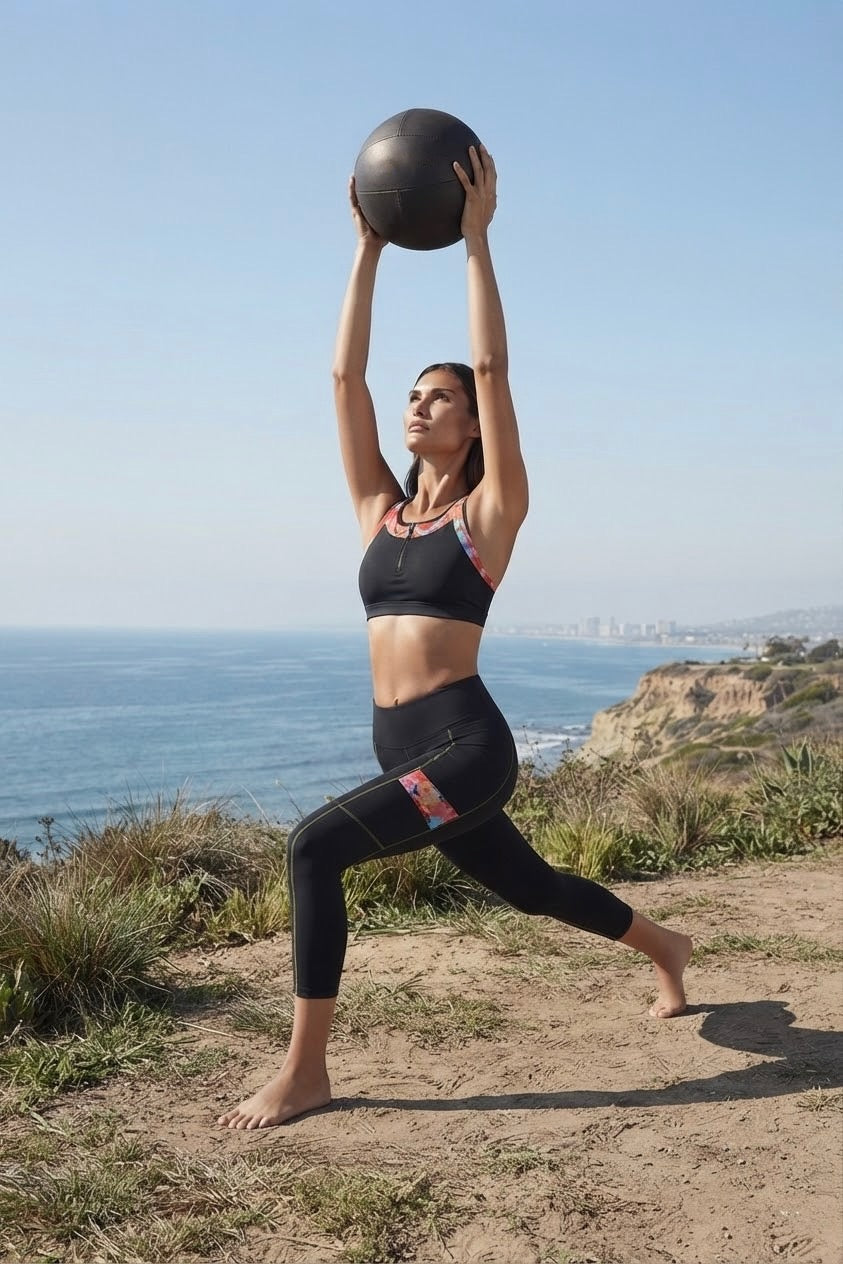
Dress for the Environment, Not Just the Workout
Outdoor fitness asks more from clothing than an air-conditioned studio does.
Temperatures change.
You sweat.
Wind picks up.
The sun comes out.
Then disappears.
You may sit on grass, walk between stations, stretch, run, lift, and cool down without ever changing clothes.
Look for:
- Moisture-wicking technical fabrics
- Four-way stretch
- Support appropriate for your activity
- Secure storage for keys and phones
- Comfortable compression
- Lightweight layering pieces
- UPF-rated fabrics when available
- Construction that stays in place while you move
At SportPort Active, this has always been part of our design philosophy: activewear should support the experience rather than become another thing you have to manage during it.
Because if you're halfway through an outdoor class adjusting your waistband for the fifth time...
You're thinking about the wrong thing.
Maybe Your Workout Doesn't Need to Get Harder. Maybe It Needs to Get Better.
For years, fitness culture told us that progress meant more.
More intensity.
More sweat.
More miles.
More weight.
More discipline.
But perhaps there is another way to improve a workout.
Change the environment.
Add sunlight.
Add trees.
Add people.
Add laughter.
Add enough novelty that Wednesday's class doesn't feel exactly like Monday's.
The emerging science of green exercise doesn't tell us that indoor workouts are bad or that every outdoor class will transform your mental health.
Research still has limitations, and scientists continue to call for better long-term studies.
What the evidence increasingly suggests is something more practical:
Exercise doesn't happen in a vacuum.
Where we move...
Who we move with...
How much we enjoy it...
And whether we want to return...
May influence the value we ultimately get from the workout.
For women juggling careers, children, relationships, aging parents, appointments, errands, and the relentless logistics of everyday life, that matters.
We don't necessarily need another obligation.
We need movement that gives something back.
So find the park yoga class.
Join the neighborhood walking group.
Try the outdoor strength circuit.
Convince a friend to come with you.
Get a little sunlight.
Breathe actual outdoor air.
And if a bird steals your resistance band...
We cannot help you with that.
But we can almost guarantee you'll remember the workout.
At SportPort Active, we believe fitness should help you build a bigger, healthier, more interesting life—not simply a better gym routine.
Sometimes the best way to do that is surprisingly simple.
Take the class outside.
Read more

Discover SportPort Active Youth Setis and Cloud styles for teen girls, plus expert tips for keeping young athletes moving through yoga, dance, walking, training and play.
Discover the hidden craftsmanship behind the Apex Sculpt Bra, from Made-in-USA construction and expert compression engineering to chafe-free seams, premium fabric, and athlete-tested performance.