


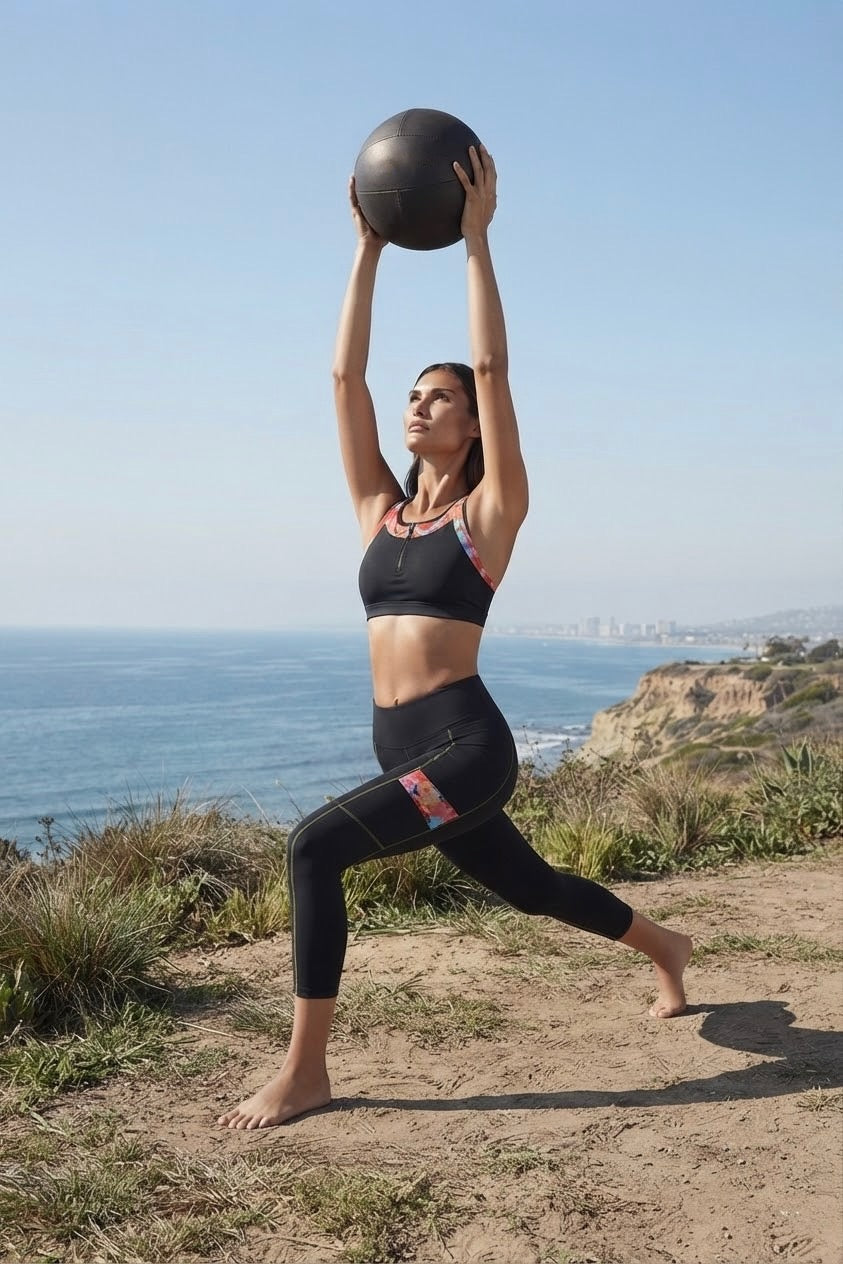
Beyond Support: The Hidden Craftsmanship Behind the Apex Sculpt Bra
Turn a sports bra inside out.
Seriously.
That's where the interesting stuff is.
Most of us shop for a sports bra by looking at what we can see: the silhouette, color, neckline, straps, zipper, perhaps the fabric.
But some of the most important decisions in a performance bra are hidden against your skin.
How many layers of fabric meet beneath your arm?
How was that seam finished?
Does the stitching stretch at the same rate as the fabric?
Will a tiny ridge begin rubbing after mile 12?
Does the thread feel soft after an hour of sweating?
Can the fabric recover after being stretched thousands of times?
Will the bra continue supporting you when you're running, riding a horse, swinging a pickleball paddle, cycling, lifting, or transitioning from the swim portion of a triathlon?
Those questions became an obsession when we developed the Apex Sculpt Bra.
We didn't want to create another attractive sports bra and call it "high performance."
We wanted to build the bra differently.
So we spent two years testing it on professional fit models and athletes, making adjustments, creating new samples, revising patterns, studying compression, changing construction, and testing again.
And again.
Until there wasn't another change we believed would make it better.
That's the story we're telling today.
Not another list of five reasons women need a supportive sports bra.
This is the story of what it actually takes to build one.

Why "Made in the USA" Was an Engineering Decision
You'll see Made in USA on the Apex Sculpt Bra.
For us, that wasn't chosen simply because it sounded good on a label.
It was part of the engineering strategy.
Compression fabric is remarkably unforgiving.
A conventional fabric can lie relatively quietly on a cutting table. High-performance stretch fabric behaves differently. It stretches, recovers, shifts and responds to tension. During manufacturing, the relationship between the fabric, needle, thread, machine tension and operator becomes extremely important.
Industry sewing specialists have documented some of the problems that can occur when stretch fabrics are treated like ordinary textiles. American & Efird's technical guidance, for example, explains that fabrics containing spandex require different approaches to seam construction because their increased stretch makes problems such as seam puckering more difficult to control.
Now imagine those challenges inside a maximum-support sports bra.
The garment isn't merely expected to look smooth on a hanger.
It has to stretch around a moving body, provide compression, recover repeatedly, withstand perspiration, carry structural tension and remain comfortable against bare skin.
That's specialized manufacturing.
During Apex development, SportPort deliberately sought out people who understood that difference.
We hired compression specialists with deep experience specifically in bra construction and stretch textiles.
Both had spent approximately 20 years working at a renowned bra manufacturer before bringing that knowledge to SportPort.
Their expertise wasn't decorative.
It influenced how the pattern was created, how the fabric was handled, where seams met, how much tension the construction could tolerate, and how the finished garment felt against the body.
That was one of the primary reasons we made the conscious decision to keep Apex manufacturing in the United States, despite the substantially higher cost.
We weren't searching for the lowest-cost place to sew a sports bra.
We were searching for people we trusted to build this sports bra.

America's Connection to Stretch Fabric Goes Back Further Than You Might Think
There's an interesting piece of American textile history behind that decision.
Modern spandex itself has American roots.
In 1958, DuPont chemist Dr. Joseph Shivers invented the revolutionary stretch fiber originally known as Fiber K. It eventually became LYCRA® fiber—the original branded spandex/elastane fiber that helped transform foundation garments, swimwear, fashion and eventually athletic apparel.
The LYCRA Company notes that the fiber could stretch dramatically and return to its original shape, providing a lighter, more durable alternative to the rubber-based elastic materials that preceded it.
That history doesn't mean every American factory today is automatically an expert in compression apparel.
Far from it.
True compression expertise remains specialized.
But America's early connection to elastane textiles is an interesting chapter in the history of the very materials that eventually made modern performance apparel possible.
For SportPort, the practical question was much simpler:
Where could we find the expertise required to make Apex the way we wanted it made?
For this garment, our answer was here at home.
Why We Spent Two Years Making One Sports Bra
Two years sounds excessive.
Unless you've tried to perfect a sports bra.
Then it begins to sound completely reasonable.
The human torso is constantly changing shape during exercise. Arms swing. Shoulders rotate. The rib cage expands with breathing. Skin moves. Breast tissue moves independently. Sweat changes friction. A garment that feels wonderful while standing in a fitting room can behave very differently twenty minutes into a run.
And sports-bra problems remain surprisingly common.
In a study involving 1,285 female runners associated with the London Marathon, 75% reported bra-fit problems, with chafing and shoulder straps digging in among the most common complaints.
A newly published 2026 study of elite and national-level female football officials found that 93% reported at least one breast- or bra-related issue at baseline. When a subgroup received individually assessed high-support bras, satisfaction improved in fit and support while breast pain decreased.
Those aren't trivial details.
They're evidence that support alone isn't enough.
A bra can compress aggressively and still be uncomfortable.
It can reduce movement and still rub.
It can look technically sophisticated and still develop a pressure point exactly where you don't want one.
That's why Apex development couldn't happen entirely on a computer or mannequin.
We used professional fit models.
Then we used athletes.
We watched.
We listened.
We adjusted.
Because athletes will reveal problems that static fitting never can.

The Underarm Test: Where Good Bras Often Go Bad
Here's a detail almost nobody talks about.
Look underneath the arm of an ordinary sports bra where several pieces of fabric meet.
That intersection can become a tiny mountain of material.
Multiple fabric layers.
Seam allowance.
Elastic.
Thread.
Binding.
Perhaps another reinforcement layer.
Put that little mound against warm, perspiring skin and repeat an arm swing thousands of times.
Now run a marathon.
Suddenly, a few millimeters of excess bulk matter.
This is one reason a sports bra can feel completely fine when you put it on—and become absolutely maddening later.
Research supports just how common these problems can be. Chafing and straps digging into the body were among the leading complaints reported by female marathon runners in published sports-bra research.
Apex was engineered specifically to avoid those bulky intersections and unnecessary pressure points.
Our construction specialists worked to make the interior clean and controlled, carefully resolving the places where fabric panels and seams converge rather than allowing everything to pile up against the skin.
The result is something we're particularly proud of:
Our bras are as beautiful on the inside as they are on the outside.
Turn one inside out and inspect it.
That's intentional.

We Obsess Over Thread Because Your Skin Notices
Thread seems like an absurdly small detail.
Until you wear the wrong one for three hours.
A sports bra lives directly against some of the body's most movement-intensive and friction-prone areas.
The stitching needs to survive repeated stretching without becoming a rigid line running across a flexible fabric.
It also needs to feel good.
SportPort chose a premium thread with a soft, almost fluffy hand specifically because the stitching repeatedly touches bare skin.
The goal wasn't simply to prevent the seam from breaking.
We wanted the thread itself to participate in comfort.
We also wanted longevity.
If you've invested in premium compression fabric designed to retain its shape and recovery, the stitching shouldn't be the first part of the garment to fail.
So we engineered the thread and seam system to work with the fabric rather than against it.
Research into sports-bra design increasingly shows why these details matter. Scientists have found that characteristics such as construction, neckline, underband design and materials can influence breast movement and performance, while separate studies have examined how bra pressure affects comfort and support perception.
There is no single feature that makes a great sports bra.
It's the system.
The Inside Shouldn't Look Like an Afterthought
There's another construction detail we almost never see discussed in activewear marketing:
The stitching should look intentional from both sides.
The Apex interior doesn't become a forgotten collection of rough seam allowances, stray threads and unfinished-looking intersections simply because customers aren't supposed to see it.
The stitching is engineered and finished so the inside remains clean.
Why invest so much effort in something hidden beneath your clothing?
Because you feel it.
Premium construction isn't only about what photographs beautifully.
It's about the parts touching you when nobody is looking.
That philosophy extends to the outside, where the Apex yoke receives decorative stitching as an intentional design element.
Technical doesn't have to mean clinical.
Strong doesn't have to mean bulky.
And maximum support certainly doesn't have to mean boring.
Then We Asked the Fabric to Do Even More
The Apex Sculpt Bra uses a premium warp-knit compression fabric, but there's another reason we chose this particular category of textile.
It shares characteristics prized in luxury performance swimwear.
Think about what a high-end swimsuit fabric is expected to do.
Get completely wet.
Dry quickly.
Stretch significantly.
Recover.
Stay smooth.
Maintain its shape.
Feel good against bare skin.
Survive repeated use.
And still look beautiful.
Those are remarkably useful qualities in a performance sports bra.
The Apex fabric has a smooth, soft hand rather than the rougher feel sometimes associated with aggressive compression. It manages moisture, dries quickly and offers the controlled stretch and recovery required for high-impact support.
That becomes especially interesting when one bra moves across different sports.
One Bra, Very Different Athletes
A marathoner and an equestrian don't move the same way.
Neither does a triathlete or pickleball player.
Yet each athlete creates a different test for the same garment.
Running and marathons involve thousands upon thousands of repetitive impacts. Here, consistent support, moisture management, anti-chafing construction and a bra that doesn't require mid-run adjustment become critical.
Triathlon adds an entirely different challenge. A garment may move from water to cycling to running, making quick-drying, shape-recovering performance fabric particularly valuable.
Equestrian riding creates repeated vertical movement through the walk, posting trot, canter and jumping while the rider's upper body must remain balanced and controlled. Support needs to feel secure without becoming distracting beneath riding layers.
Pickleball and tennis add rapid lateral movements, rotation, reaching, starts, stops and directional changes.
Then there are HIIT workouts, strength training, hiking, cycling, rowing, gym sessions and everyday training.
We didn't want a bra built around one photograph of one athlete performing one movement.
We wanted something versatile enough to move wherever women do.
That's why we call Apex a performance system rather than simply a running bra.

The Phone Pocket Made Everything Harder
As though developing a maximum-support compression bra wasn't enough, we gave our engineers another problem.
Put a phone in it.
Not beside it.
Not in a loose belt.
Not bouncing around behind the wearer.
Inside the architecture of the bra.
That changed everything.
A smartphone has weight.
Weight changes balance.
Balance changes compression.
Add movement, and poor engineering quickly becomes obvious.
The phone needed to stay secure without pulling the garment downward, distorting the fit or creating an uncomfortable pressure point.
That's why the Apex Sculpt Bra incorporates SportPort's patented front zip phone pocket as part of the structure rather than treating storage as an afterthought. The current Apex also includes a high neckline, racerback, locking front zipper, premium warp-knit compression, controlled four-way stretch, moisture management and UPF 50+ fabric.
The pocket also incorporates SportPort's patented shielding technology. We prefer to describe that feature responsibly: it is designed as an additional exposure-reduction layer while providing secure device storage, not as a substitute for established health guidance.
But from a pure garment-engineering perspective, the phone itself presented an extraordinary design challenge.
The bra had to support you and what you carry.
Why We Didn't Send Apex to the Lowest Bidder
Could we have manufactured Apex for less overseas?
Yes.
That was never really the question.
The question was:
What would we have to give up to do it?
For SportPort, Apex had already required experienced bra engineers, specialized pattern making, difficult compression fabrication, repeated fittings, athlete wear testing, precision finishing and two years of development.
Changing the manufacturing strategy simply to reduce cost would have contradicted the reason we spent those two years developing the garment in the first place.
So we made a deliberate decision.
Premium construction over lowest cost.
Specialized expertise over convenience.
Quality control over maximum volume.
Made in America not as decoration—but as part of how we believed this particular garment needed to be built.
That's an important distinction.
The Real Definition of a Luxury Sports Bra
Luxury activewear is often defined by price.
We think that's backwards.
Luxury should be visible in the decisions.
The patternmaker who adjusts a fraction of an inch because something isn't sitting correctly.
The compression specialist who understands how stretch changes under tension.
The sewer who knows exactly how to guide difficult fabric through a machine without distorting it.
The thread you barely notice because it doesn't irritate your skin.
The seam intersection that isn't bulky.
The inside construction nobody sees.
The sample that gets rejected even though it is "probably good enough."
The athlete who identifies a problem nobody noticed on the fit model.
The next sample.
And the next one.
Two years later, that's what you're actually wearing.
Not simply fabric and thread.
Decisions.
Sometimes the Best Feature Is the One You Never Notice
When the Apex Sculpt Bra is doing its job, you shouldn't spend your workout thinking about it.
You shouldn't be wondering why something is digging beneath your arm.
You shouldn't be moving a strap back into position.
You shouldn't be thinking about a rough seam.
You shouldn't be worried about your phone falling out.
You should be thinking about the trail ahead.
The finish line.
Your horse.
The next point.
The next mile.
The next rep.
That's why some of our proudest design details are almost invisible.
And maybe that's the real difference between a sports bra that's simply manufactured and one that's been engineered.
The SportPort Apex Sculpt Bra is Made in the USA because, for us, American manufacturing wasn't the final line added to a product description.
It was one of the first decisions we made about how this bra would be built.
We spent two years getting Apex right.
Then we put our name on it.
Because when a garment sits this close to your body and works this hard alongside you, "good enough" was never going to be good enough.
Read more

What If Your Workout Could Do More Than Work Your Muscles? Picture two Tuesday mornings. In the first, you drive to the gym, walk beneath fluorescent lights, find your place in a crowded studi...
Find the best workout split for your schedule and sport. Compare 2-, 3- and 4-day strength plans for running, tennis, golf, riding, swimming and more.