


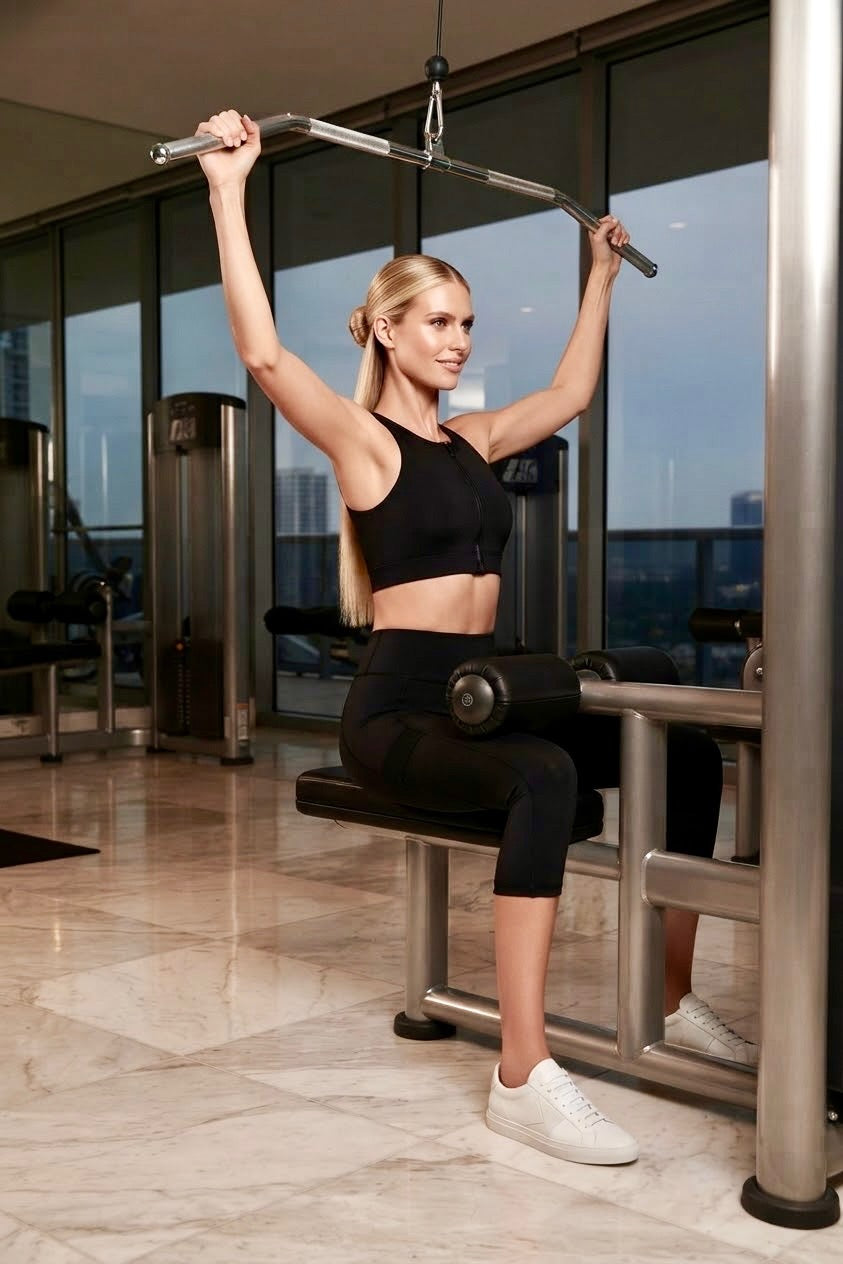
Stop Copying Her Workout: The Best Workout Split Is the One That Fits Your Life
Open social media on a Monday morning and apparently every woman on Earth is supposed to be doing legs.
Tuesday?
Upper body.
Wednesday?
Glutes again, naturally.
By Thursday, you've missed two workouts because your daughter's practice ran late, played three sets of tennis, walked the dog six miles, and somehow you're supposed to feel guilty because you didn't complete "Pull Day."
We think there is a better way.
Because the question shouldn't be:
What's the best workout split?
It should be:
What's the best workout split for me?
For your schedule.
Your goals.
Your recovery.
Your experience.
And perhaps most importantly, everything else you already do.
A runner shouldn't automatically train like a bodybuilder.
A competitive tennis player doesn't need the same weekly layout as someone whose primary activity is strength training.
An equestrian riding four days a week has different demands than a golfer playing twice a week.
And the woman juggling work, family, Pilates, pickleball, walking and weekend hikes doesn't need a seven-day spreadsheet just to become stronger.
Welcome to what we're calling The Split Match.
Instead of copying someone else's training calendar, we're going to match the structure of your strength program to the life you're actually living.

First Things First: What Is a Workout Split?
A workout split is simply the way you divide resistance training across the week.
That's all.
A full-body split trains most major muscle groups during each workout.
An upper/lower split separates upper- and lower-body training onto different days.
A push/pull/legs split divides sessions according to movement patterns.
Body-part splits might assign individual days to legs, back, shoulders or other muscle groups.
None of these formats contains magical properties.
In fact, one of the most useful recent findings in resistance-training research is that full-body and split routines appear capable of producing similar improvements in strength and muscle growth when total training volume is comparable.
A 2024 systematic review and meta-analysis examined 14 studies involving 392 participants and found no meaningful difference between split and full-body routines for strength or muscle growth when weekly volume was matched. Researchers concluded that people can confidently choose according to personal preference.
That's incredibly freeing.
Because it means the best split doesn't necessarily belong to the person with the fanciest spreadsheet.
It belongs to the woman who can actually do it.
Meet One of the Experts Changing the Conversation
One researcher worth knowing in this conversation is Dr. Brad Schoenfeld, professor of exercise science at Lehman College and director of its Human Performance and Fitness graduate program.
Schoenfeld has published more than 300 peer-reviewed papers, much of his research focusing on resistance training, muscle development and how manipulating training variables affects results. In 2026, the National Strength and Conditioning Association honored him with its William J. Kraemer Outstanding Sports Scientist Award.
Importantly for women, Schoenfeld coauthored a randomized study comparing two very different schedules in previously untrained women.
One group performed two full-body workouts each week.
The other trained four days using a split-body routine.
The weekly exercises and training volume were equivalent.
After 12 weeks, both groups improved strength, power and muscle mass—with no meaningful advantage to the four-day split.
In practical terms:
Two well-designed days can work.
Four days can work too.
The calendar isn't the secret.
Consistency, progressive training and enough quality work are.
Think of Your Week as a Training Pie
This is where active women need to think differently.
Your strength workouts are only one slice of your total training pie.
Suppose your week includes:
- Monday tennis.
- Tuesday strength training.
- Wednesday pickleball.
- Thursday strength training.
- Friday rest.
- Saturday tennis.
- Sunday hiking.
That's already a substantial amount of physical activity.
Your body does not look at Thursday's gym workout and say:
"Don't worry. Tennis doesn't count because it wasn't strength day."
Everything counts.
Running creates fatigue.
Swimming creates fatigue.
Horseback riding creates fatigue.
Golf tournaments create fatigue.
Skiing creates fatigue.
Sleep loss creates fatigue.
So does stress.
Your ideal workout split needs to distribute training in a way that gives your body enough stimulus to become stronger without turning every day into another hard day.
That's why a split can be so useful.
It organizes stress.
It gives muscle groups time to recover.
It makes your training more predictable.
And it helps prevent the classic mistake of exercising hard seven days a week while wondering why you don't feel particularly good.
The SportPort 2-3-4 Split Match
Rather than declaring one routine superior, use this simple framework.
| Your Available Strength Days | Best Starting Combination | Often Works Well For |
|---|---|---|
| 2 days | Full Body A + Full Body B | Runners, equestrians, tennis/pickleball players, swimmers, golfers, cyclists, triathletes, busy schedules |
| 3 days | Full Body / Full Body / Full Body OR Lower / Upper / Full | Women balancing sport and strength equally |
| 4 days | Upper / Lower / Upper / Lower | Women who enjoy lifting and want strength or muscle development to be a larger priority |
Notice what's missing?
A recommendation that every woman train six days.
Most don't need to.
Current CDC guidance recommends muscle-strengthening activity involving all major muscle groups on at least two days each week, alongside aerobic activity.
Two strength sessions aren't a consolation prize.
They can be an excellent program.

Combination #1: The Two-Day Full-Body Split
For many active women, this is our favorite starting point.
Especially if you already play sports.
Day A
- Squat or leg press
- Row
- Romanian deadlift
- Chest press or push-up
- Single-leg exercise
- Loaded carry or core exercise
Day B
- Split squat or step-up
- Lat pulldown
- Hip thrust or deadlift variation
- Overhead or incline press
- Calf exercise
- Anti-rotation or trunk exercise
These sessions train most major movement patterns twice during the week without consuming your entire schedule.
Leave at least a day between them when practical.
For the woman who says, "I run, ride, play tennis and have approximately seven thousand other things going on," this may be all you need to begin getting significantly stronger.

Combination #2: The Three-Day Hybrid
Three days creates some interesting possibilities.
You could simply perform three full-body workouts.
Or try:
- Monday — Lower Body + Pull
- Wednesday — Upper Body + Single-Leg Work
- Friday or Saturday — Full Body
Why do we like this?
Because you're not hammering one body part into oblivion.
You're spreading volume across the week.
It also gives you room to emphasize different qualities.
One day can be heavier.
One can include more unilateral work.
One can be moderately loaded and athletic.
This is a particularly useful structure for women who enjoy strength training but also play recreational sports several days each week.
Combination #3: The Four-Day Upper/Lower Split
If strength training is one of your favorite activities—or you want more weekly training volume—the classic upper/lower split remains excellent.
- Monday — Upper
- Tuesday — Lower
- Thursday — Upper
- Friday — Lower
You train major muscle groups approximately twice each week while keeping individual sessions manageable.
This schedule also provides enough room to include pulling, pushing, squatting, hinging, single-leg work and core training without turning every workout into a 90-minute marathon.
But here's the key:
Four days isn't "advanced" simply because four is greater than two.
It's only better if four days fit your life and you recover well from them.
The 2024 split-versus-full-body meta-analysis reinforces exactly that point: when weekly work is comparable, neither format appears inherently superior for strength or muscle growth.
Why Strength Training Matters Even If You Already Play a Sport
This question comes up constantly.
"I play tennis three days a week. Isn't that enough?"
It's excellent physical activity.
But it's not the same stimulus as progressive resistance training.
The latest evidence specific to women is impressive.
A 2026 systematic review and meta-analysis examined 126 studies involving more than 4,000 women and found resistance training significantly improved muscular strength in both premenopausal and postmenopausal women.
Researchers also found favorable changes in functional mass and fat mass and concluded that broad resistance-training principles can work across the female lifespan—with individualization being more useful than rigid age- or sex-based rules.
That last part is important.
Women don't need gimmicky "female" exercises.
We need good strength training appropriately programmed for the individual woman.
The NSCA's new 2026 position statement on female athletes reaches a similar conclusion: sex-specific considerations can matter, but fundamental principles such as progressive overload still apply.

If You Run: Strength Should Help You Run
Running already gives your legs enormous amounts of repetitive endurance work.
Your strength program doesn't need to become another cardio session.
Instead, prioritize:
- Squats.
- Split squats.
- Romanian deadlifts.
- Calf raises.
- Hip extension.
- Rows.
- Loaded carries.
- Trunk strength.
For many recreational runners and marathoners, two full-body strength sessions per week are far easier to integrate than a high-volume bodybuilding split.
Most importantly, don't schedule your hardest lower-body workout directly before the long run you've been preparing for all week.
Your split should support your miles.
Not ruin Saturday morning.

If You Play Tennis, Pickleball, Racquetball or Squash
Racquet sports already provide plenty of:
- Rotation.
- Lateral movement.
- Acceleration.
- Deceleration.
- Starting.
- Stopping.
- Reaching.
- Reacting.
What can the gym add?
- More strength to absorb force.
- Better single-leg control.
- Stronger hamstrings and glutes.
- Upper-back strength.
- Shoulder stability.
- Anti-rotation trunk strength.
Female tennis research supports the value of physical training: a systematic review and meta-analysis found improvements in strength, power, agility, serve velocity and serve accuracy following structured physical-training programs, although the authors noted that female-specific evidence remains limited.
For frequent racquet-sport players, two or three strength days are usually much easier to integrate than a four- or five-day body-part split.
And please don't schedule a heroic leg day the afternoon before league finals.
Your doubles partner will not appreciate your dedication.

If You Golf: Build the Engine Behind the Swing
Golf may look graceful.
The forces behind an effective swing are anything but passive.
Lower-body strength helps create and transfer force.
The trunk coordinates rotation.
The upper body completes the chain.
A systematic review focused on female golfers ound that strength, power and flexibility training could positively influence clubhead speed.
A smart golf-oriented program might emphasize:
- Squats.
- Deadlift variations.
- Split squats.
- Rows.
- Loaded carries.
- Rotational and anti-rotational trunk work.
- Power exercises when appropriate.
Two or three strength sessions can fit beautifully around golf.
And contrary to the old myth, becoming stronger does not require becoming stiff.

If You Ride Horses: Train Off the Horse Too
Equestrian athletes are interesting because riding already asks for enormous amounts of subtle muscular control.
- Core stabilization.
- Hip mobility.
- Adductor endurance.
- Postural strength.
- Balance.
- Coordination.
But hours in the saddle can also mean hours in repeated positions.
That's where strength training can fill the gaps.
Focus on:
- Glutes.
- Hamstrings.
- Upper back.
- Single-leg strength.
- Hip stability.
- Core control.
- Loaded carries.
A two-day full-body split works exceptionally well for women riding several days per week.
If riding volume decreases during winter or the off-season, that's a perfect time to experiment with three strength days.
If You Swim: Don't Just Add More Shoulder Work
Swimming already involves tremendous repetitive upper-body activity.
So a swimmer's gym program shouldn't simply consist of endless shoulder exercises.
Think whole body.
- Leg strength.
- Hip extension.
- Rows and pulling balance.
- Scapular control.
- Trunk stability.
- Appropriate pressing.
Strength training can complement swimming performance, and research in competitive swimmers has found favorable effects from resistance-based programs on strength and some swimming-performance measures.
The scheduling detail matters.
Don't place your heaviest upper-body session immediately before your hardest swim workout if it consistently leaves your shoulders exhausted.
Again:
Match the split to the sport.

If You Cycle or Train for Triathlons
Triathletes already have a fascinating scheduling problem.
Swim.
Bike.
Run.
Now add strength?
Yes—but efficiently.
Two well-designed full-body strength sessions are often the most realistic combination because endurance training already takes up so much weekly bandwidth.
Cyclists may similarly benefit from strategic strength work rather than simply adding another endurance session.
The goal isn't to become tired in more creative ways.
It's to develop strength qualities that repetitive endurance training alone may not fully maximize.
Don't Forget Skiing, Hiking, Rowing, Volleyball, Soccer & Everything Else
The same principle applies across sports.
Skiers and hikers can benefit from eccentric leg strength, single-leg control, calves and posterior-chain development.
Rowers can benefit from leg strength, posterior-chain capacity, upper-back work and trunk control.
Volleyball and basketball players need strength, power, landing control and deceleration.
Soccer and lacrosse players already perform huge amounts of running and cutting, making strength and neuromuscular work an important complement.
Yoga, Pilates and dance enthusiasts often have excellent movement control and mobility but may benefit from progressively loaded squats, hinges, rows, presses and carries.
You don't have to abandon the activity you love to become stronger.
Strength training should make that activity easier to continue.
The Best Split for Women 30–50 May Change Throughout the Year
This is a piece of fitness advice we wish more women heard.
You are allowed to change your workout split.
Your training doesn't need to look identical in January and July.
Tennis season?
Lift twice.
Winter?
Perhaps you enjoy four days in the gym.
Training for a marathon?
Keep strength concise while mileage rises.
Race finished?
Shift toward three strength sessions.
Riding heavily during show season?
Two days may be plenty.
Traveling?
One or two efficient full-body sessions can preserve the habit.
This isn't inconsistency.
It's intelligent programming.
Professional athletes change training according to competition schedules.
Why wouldn't you?
Recovery Belongs in the Split Too
There is another workout category social media doesn't photograph very often.
Recovery.
Muscle doesn't become stronger because you punish it continuously.
Training provides the stimulus.
Adaptation happens afterward.
Sleep, nutrition, stress, training history and the demands of your sport all affect how much work you can productively tolerate.
The latest NSCA guidance for female athletes emphasizes comprehensive, individualized programming rather than reducing women to a simplistic hormonal formula.
Some weeks you'll feel terrific.
Some weeks you won't.
One hard session doesn't prove you're fit.
One lighter week doesn't mean you're losing progress.
Consistency across months matters far more than winning Tuesday.
The 30-Second Split Test
Before choosing your next workout plan, answer four questions.
How many days can I realistically strength train for the next three months?
Not your fantasy week.
Your real week.
What sport or activity already takes the most out of me?
That's part of your training load.
What am I trying to improve?
Strength?
Sports performance?
Muscle?
Healthy aging?
All-around fitness?
Which schedule will I still be willing to follow when life gets busy?
There is your answer.
Two days?
Excellent.
Three?
Wonderful.
Four?
Go for it.
The number itself isn't the victory.
Consistency is.
The SportPort Split Match
If you're still not sure, start here:
You play a sport 3–5 days per week:
Choose 2 full-body strength days.
You play a sport 1–3 days and want strength to matter equally:
Choose 3 strength days, either full-body or lower/upper/full-body.
Strength training is one of your primary activities:
Try a 4-day upper/lower split.
You're returning after a long break:
Begin with 2 full-body days and earn the right to add more.
Your schedule is chaotic:
Full-body training gives you flexibility. If you miss Thursday, you haven't accidentally gone nine days without training your back.
Simple works.
Stop Looking for the Perfect Split
There probably isn't one.
There is only the split that fits this version of your life.
The woman training for her first marathon.
The golfer trying to add distance.
The rider who wants better stability.
The swimmer who wants more strength.
The tennis player who wants another strong season.
The pickleball fanatic whose "quick game" somehow lasts three hours.
The mom trying to feel strong again.
The woman entering her 40s who suddenly realizes strength is something she wants to protect for the next forty years.
They don't need the same calendar.
They need the same fundamental idea:
Train intelligently.
Challenge your muscles.
Recover.
Repeat.
At SportPort Active, we've always believed performance is personal.
Your body isn't a template.
Your sport isn't a template.
Your life certainly isn't a template.
So instead of asking what workout split everyone else is doing, ask a better question:
What combination will help me become stronger while still leaving enough energy to enjoy the life I'm getting strong for?
Find that split.
Then make it yours.
Read more
Discover the hidden craftsmanship behind the Apex Sculpt Bra, from Made-in-USA construction and expert compression engineering to chafe-free seams, premium fabric, and athlete-tested performance.

From magnesium to creatine, discover the science-backed supplements top health experts recommend for active women 30–60 — plus what's coming next in nutrition trends.