


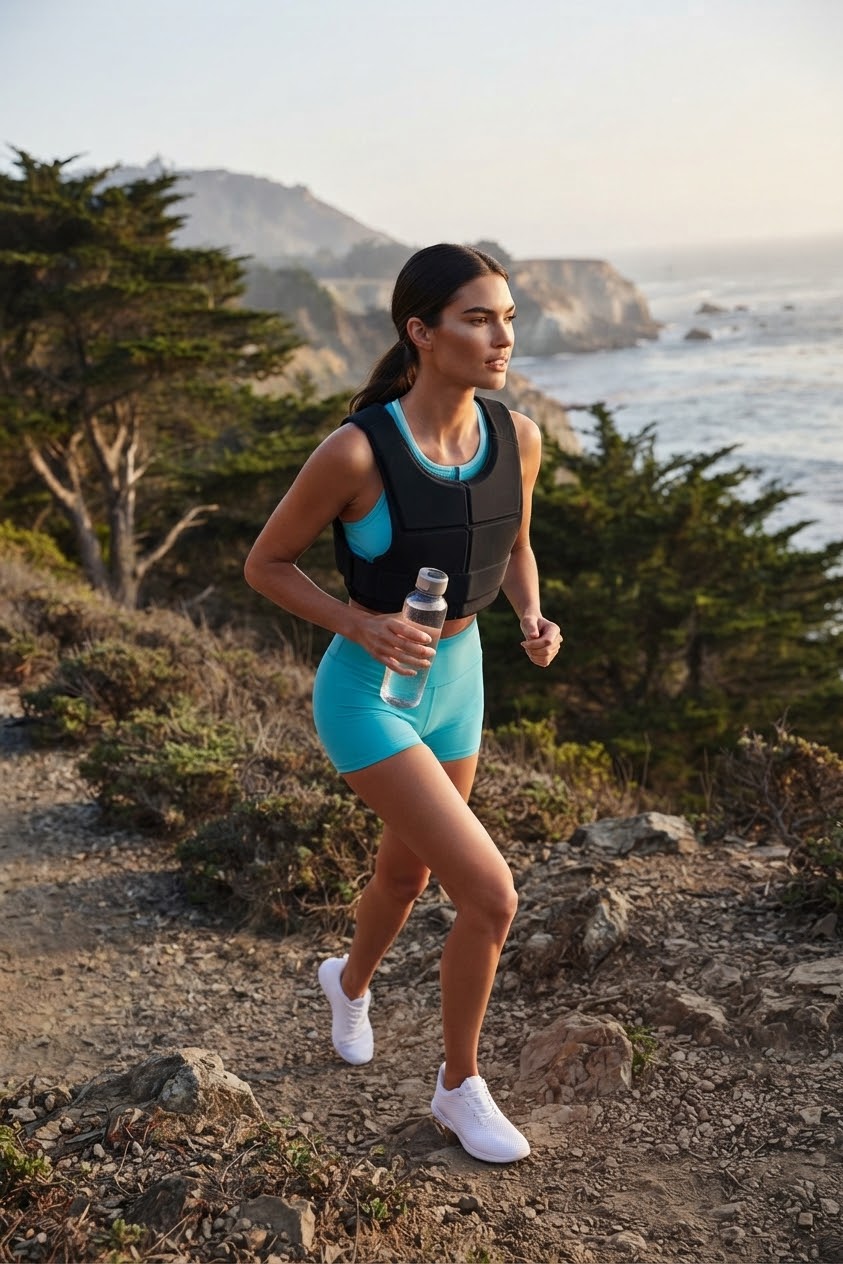
The Fitness Transfer Effect: How One Sport Can Make You Better at Another
Your golf bag says golf.
Your running shoes say running.
Your yoga mat says yoga.
Your saddle definitely says equestrian.
But your muscles?
They aren't reading labels.
Your glutes don't know whether they're stabilizing you through a tennis lunge, supporting you in the saddle, or driving you out of a squat.
Your core doesn't particularly care whether it's resisting rotation during a deadlift, controlling your golf swing, or keeping you centered on a horse.
Your cardiovascular system doesn't know whether your heart rate climbed because you're running, playing racquetball, swimming laps, or attempting to survive an especially enthusiastic aerobics instructor.
The body recognizes demands.
Strength.
Balance.
Power.
Endurance.
Mobility.
Coordination.
Reaction.
Stability.
And here's where fitness becomes much more interesting:
What you develop in one sport can sometimes help you somewhere completely different.
We're calling it the Fitness Transfer Effect.
The idea isn't that playing tennis magically makes you a better golfer or that yoga automatically improves your 10K time.
Sport-specific skill still has to be practiced.
But the physical qualities beneath those skills can overlap dramatically.
And once you start recognizing those connections, your entire approach to fitness changes.

Think of Fitness as Athletic Currency
Imagine every activity depositing something different into your athletic bank account.
Running deposits endurance.
Weight lifting deposits strength.
Yoga deposits mobility and control.
Horseback riding deposits balance and postural stability.
Tennis deposits agility and reaction.
Golf develops rotational coordination.
Racquetball adds speed and rapid changes of direction.
Aerobics develops cardiovascular fitness, rhythm and coordination.
The question isn't:
Which one is best?
It's:
Which qualities do I already have—and which ones am I missing?
That distinction matters because most sports are incomplete by themselves.
A runner can have outstanding cardiovascular endurance but relatively little upper-body strength.
A golfer may have excellent rotational skill but lack lower-body strength.
A yogi may have wonderful mobility but benefit from more progressive external loading.
A rider may possess exceptional balance while still gaining from stronger glutes and hamstrings.
Cross-training lets one activity fill the gaps left by another.
The Science Says Women Can Train More Than One Quality at Once
For years, athletes worried that mixing endurance training with strength training would somehow ruin progress in both.
Research in women paints a more encouraging picture.
A systematic review examining concurrent strength-and-endurance training in healthy adult women found that combining the two generally improved both strength and endurance capacity. The researchers also emphasized that female-specific evidence remains more limited than we'd like, so individualization still matters.
A broader analysis of concurrent training also found no clear lower-body strength penalty in women compared with resistance training alone, though more research in highly trained female athletes is still needed.
Translation?
You don't necessarily have to choose between being strong and having endurance.
You can build both.
And for most recreationally active women, that is excellent news.

Weight Lifting: The Sport That Quietly Helps Almost Everything Else
If there is one training method with unusually broad crossover potential, it's resistance training.
Why?
Because nearly every sport requires you to produce, absorb, or control force.
A major 2026 review analyzed 126 studies involving more than 4,000 women and found that resistance training significantly improved strength in women across the adult lifespan. The researchers concluded that general resistance-training principles appear useful broadly, with individualization more important than rigid age-based formulas.
Strength gives other sports a larger engine.
For runners, stronger legs may help tolerate training demands.
For riders, stronger glutes, hamstrings and upper backs can support position and control.
For golfers, strength and power can contribute to clubhead speed.
For tennis and racquetball players, lower-body strength supports acceleration and braking.
For swimmers, resistance training provides loading that water alone doesn't fully replicate.
And for women in their 30s, 40s and 50s?
Strength has another advantage.
It helps preserve physical capacity for everything else you want to continue doing.
Golf + Weight Training: Build the Engine Behind the Swing
Golf may be one of the clearest examples of transfer.
The swing is highly technical.
You cannot deadlift your way into a beautiful golf swing.
But physical capacity still matters.
A systematic review focused specifically on female golfers found clubhead speed was associated with measures of strength, lower- and upper-body power, and flexibility. Training interventions also produced meaningful improvements in clubhead speed.
That's the Fitness Transfer Effect in action.
Golf develops coordination and repeated rotational skill.
Strength training adds force.
Yoga can add mobility and balance.
Walking the course adds endurance.
Put those pieces together and suddenly "golf fitness" extends far beyond hitting balls at the range.
The crossover:
Golf gives yoga: rotational control and concentration.
Yoga gives golf: mobility, balance and body awareness.
Weights give golf: force production and strength.
Walking/running gives golf: stamina for long rounds.
Nobody needs to become a powerlifter to enjoy golf.
But a stronger golfer may have more physical capacity available for the swing.

Tennis + Racquetball + Aerobics: The Footwork Family
Tennis and racquetball may look different, but underneath they share a surprising amount.
Both demand:
Rapid reactions.
Lateral movement.
Acceleration.
Deceleration.
Rotation.
Hand-eye coordination.
Repeated bursts of effort.
This is why traditional aerobics, dance cardio and agility work can complement racquet sports better than many women realize.
Aerobics develops rhythm, cardiovascular endurance and the ability to coordinate movement while fatigued.
Racquet sports then ask you to apply those qualities unpredictably.
Tennis research supports the importance of off-court physical preparation. A systematic review in female tennis players found training programs improved measures including muscle strength, power, agility, serve velocity and serve accuracy.
The lesson isn't that aerobics teaches a forehand.
It doesn't.
But better conditioning and movement capacity give you a larger physical toolbox from which to play.
The crossover:
Aerobics gives tennis: conditioning, rhythm and footwork endurance.
Tennis gives aerobics: reaction and multidirectional movement.
Weights give racquet sports: strength for acceleration and deceleration.
Yoga gives racquet sports: mobility and recovery.
And yes, pickleball belongs in this family too.

Running + Weights: Endurance Meets Strength
Runners love running.
This is both their greatest strength and sometimes their biggest programming challenge.
Because when you love one activity, the instinct is often:
Do more of it.
But running already gives you tremendous repetitive endurance.
Cross-training asks:
What doesn't running give you enough of?
Progressive strength.
Upper-body pulling.
Heavy hip extension.
Single-leg loading beyond your usual stride.
This is where resistance training earns its place.
Research in healthy women suggests concurrent endurance and strength programs can improve both capacities rather than requiring an either/or choice.
For recreational runners, weight training can therefore complement—not replace—the miles.
The crossover:
Running gives lifting: cardiovascular endurance and work capacity.
Lifting gives running: strength and force capacity.
Yoga gives running: mobility, control and lower-intensity movement days.
Aerobics gives running: cardiovascular variety without repeating exactly the same motion.
The goal isn't to turn every runner into a bodybuilder.
It's to give the runner a more complete body.

Yoga: The Great Connector
Yoga may have the most interesting crossover role of all.
It sits between strength, mobility, balance and body awareness.
A 2025 systematic review of randomized trials found that yoga showed favorable effects on balance in healthy people, although researchers noted variability among programs and outcomes.
Think about how valuable balance and movement awareness are across sports.
Golf requires controlled weight transfer.
Horseback riding requires continuous postural adjustments.
Running requires single-leg stability with every stride.
Tennis requires reaching and recovering from awkward positions.
Weight lifting requires body awareness under load.
Yoga doesn't replace any of those sports.
It can support the physical qualities beneath them.
The crossover:
Yoga gives riders: hip mobility and body awareness.
Yoga gives golfers: rotational mobility and balance.
Yoga gives runners: mobility and control.
Yoga gives lifters: movement options and awareness.
And the other sports give yoga something too.
Strength training can make challenging poses feel more manageable.
Running builds general endurance.
Riding develops reactive balance.
That's why crossover isn't a one-way street.

Equestrian + Yoga + Strength: The Balance Triangle
Horseback riding looks graceful precisely because riders make constant corrections that you rarely see.
Research continues to show how physically active riding actually is.
A recent pilot study measuring muscle activity found the rectus abdominis, gluteal muscles and spinal muscles all active during riding, with core-muscle activation generally increasing as gait speed increased. ()
Other research has found horseback riders outperforming non-riders in several balance tests, although these studies are relatively small and shouldn't be taken as universal proof.
Another study published recently found sport riders demonstrating better core stability than recreational riders and non-riders.
So what complements riding?
Yoga can support mobility and body awareness.
Strength training builds the glutes, hamstrings and upper back.
Aerobic exercise supports stamina during long days at the barn.
And running or hiking can provide weight-bearing conditioning outside the saddle.
The crossover:
Riding gives yoga: reactive balance.
Yoga gives riding: mobility and positional awareness.
Strength gives riding: greater physical reserve.
Cardio gives riding: endurance for long training days.
The horse may be the athlete beneath you.
You're still an athlete too.
Racquetball May Secretly Help Your Golf Game
Stay with us.
We are not suggesting you practice your golf swing inside a racquetball court.
But look beneath the skills.
Racquetball requires fast rotation.
Rapid weight transfer.
Reaction.
Footwork.
Acceleration.
Hand-eye coordination.
Golf requires controlled rotation, weight transfer, coordination and force production.
The techniques are entirely different.
The underlying athletic qualities overlap.
That's an important distinction in cross-training.
General qualities can transfer. Specific technique usually does not.
Being faster won't automatically improve your golf swing.
But possessing better coordination, stronger legs and a more athletic trunk gives your golf coach more physical capacity to work with.
Think of cross-training as upgrading the hardware.
Sport practice installs the software.
Women's Injury Prevention Gives Us Another Clue
There's another reason variety matters.
Female-athlete injury-prevention research increasingly emphasizes multiple physical qualities working together rather than relying on one exercise.
The 2025 FAIR consensus reviewed neuromuscular programs incorporating strength, balance, agility and change-of-direction work. These multi-component programs substantially reduced ACL injuries in female athletes and showed favorable effects for ankle-sprain prevention as well.
That does not mean doing yoga plus tennis automatically prevents injury.
It does reinforce a broader idea:
Athletic resilience is multidimensional.
Strength matters.
Balance matters.
Agility matters.
Coordination matters.
The body benefits from having more than one tool.
The SportPort Fitness Transfer Matrix
Here's the easiest way to identify your own crossover opportunities:
| Your Favorite Activity | What It Builds Well | What Complements It |
|---|---|---|
| Golf | Rotation, coordination, concentration | Strength, yoga, walking |
| Tennis | Agility, reaction, lateral movement | Strength, aerobics, yoga |
| Equestrian | Balance, core control, posture | Strength, yoga, cardio |
| Racquetball | Speed, reaction, rotation | Strength, mobility, endurance |
| Yoga | Mobility, balance, body awareness | Strength, running, swimming |
| Aerobics | Cardio, rhythm, coordination | Strength, yoga |
| Running | Endurance, aerobic fitness | Strength, yoga, swimming |
| Weight lifting | Strength, force production | Running, aerobics, yoga |
| Swimming | Cardio, whole-body endurance | Strength, walking/running |
| Cycling | Lower-body endurance | Strength, yoga |
| Hiking | Endurance, balance, leg stamina | Strength, yoga |
| Pickleball | Reaction, agility, coordination | Strength, aerobics, mobility |
The objective is not to do everything.
Please don't turn this chart into fourteen new obligations.
The goal is to identify one missing quality.
Then borrow it from somewhere else.
Try the Two-Sport Question
Here's a simple SportPort challenge.
Ask yourself:
What activity do I love most?
Then:
What physical quality does that activity give me the least of?
If you love running but rarely lift:
Add strength.
If you lift but rarely move aerobically:
Walk, run, cycle or swim.
If you play tennis but feel stiff:
Try yoga.
If you ride horses but fatigue during long barn days:
Build cardiovascular fitness.
If golf is your primary activity:
Add strength and mobility.
If yoga is your everything:
Try loading your muscles progressively.
You don't need seven sports.
You need enough variety to become well-rounded without becoming overwhelmed.
Women 30–50: Variety Has a Different Meaning Now
In our 20s, fitness sometimes means chasing performance.
Faster.
Farther.
Heavier.
Then life changes.
Career.
Children.
Travel.
Hormonal transitions.
Changing schedules.
Changing priorities.
By our 30s, 40s and 50s, fitness can start meaning something much more valuable:
Capability.
Can I hike on vacation?
Carry my suitcase?
Play three sets of tennis?
Ride comfortably?
Walk 18 holes?
Run with my daughter?
Learn pickleball at 48?
Lift weights confidently?
Try something new without feeling physically unprepared?
Resistance-training evidence in women now strongly supports meaningful strength gains across adulthood, with researchers emphasizing individualization rather than assuming age alone should determine what women can do.
That's why crossover matters.
We're not training for one activity.
We're training for the ability to keep choosing activities.
Beware the "More Is Better" Trap
One important caveat.
Cross-training does not mean piling every sport into the same week.
Your body still needs recovery.
Concurrent-training research suggests women can improve strength and endurance together, but program structure, total volume and recovery still matter.
If you're running five days, lifting four, playing tennis three and riding twice...
Your biggest fitness need may be a nap.
Variety should broaden your capabilities.
Not bury you in fatigue.
The Best Athletes Borrow
Watch exceptional athletes and you'll notice something.
They rarely train only the exact movement seen in competition.
Golfers lift.
Runners strength train.
Tennis players perform conditioning.
Equestrians train off the horse.
Swimmers lift weights.
Skiers cycle.
Athletes borrow physical qualities from other forms of training because sport-specific practice alone cannot develop everything.
Recreational women can use the same principle without turning life into professional training.
One sport gives you joy.
Another fills the gap.
A third might simply make you laugh.
That's enough.
Fitness Doesn't Have to Choose a Lane
Maybe this is the part of fitness culture we need to rethink.
You don't have to be:
A runner.
A yogi.
A golfer.
A rider.
A lifter.
A tennis player.
You can be a woman who runs and lifts.
Rides and practices yoga.
Golfs and hikes.
Plays pickleball and swims.
Strength trains and occasionally takes an aerobics class because the music is good and your friends talked you into it.
Your body doesn't care about maintaining a fitness identity.
It cares about the experiences and challenges you give it.
At SportPort Active, we've always believed movement should expand your life.
Not put you into another box.
So keep the sport you love.
Then occasionally borrow something from another one.
Borrow yoga's balance.
Borrow running's endurance.
Borrow lifting's strength.
Borrow tennis's agility.
Borrow riding's body awareness.
Borrow golf's rotational control.
Borrow aerobics' rhythm.
Borrow racquetball's reaction speed.
Over time, those deposits begin to add up.
You don't just become better at one sport.
You become better prepared for movement itself.
“Think of cross-training as upgrading the hardware. Sport practice installs the software.”
And for women who want to remain active for decades to come, that may be the most valuable crossover of all.
Read more
From running and racquetball to yoga, riding, golf, swimming and weights, see what 60 minutes of movement really gives you—and why calories are only one part of the story.
Gray, mauve and burgundy are having a Fall 2026 fashion moment—and SportPort’s Setis color story was already there. Explore how runway color translates into a smarter active wardrobe.