


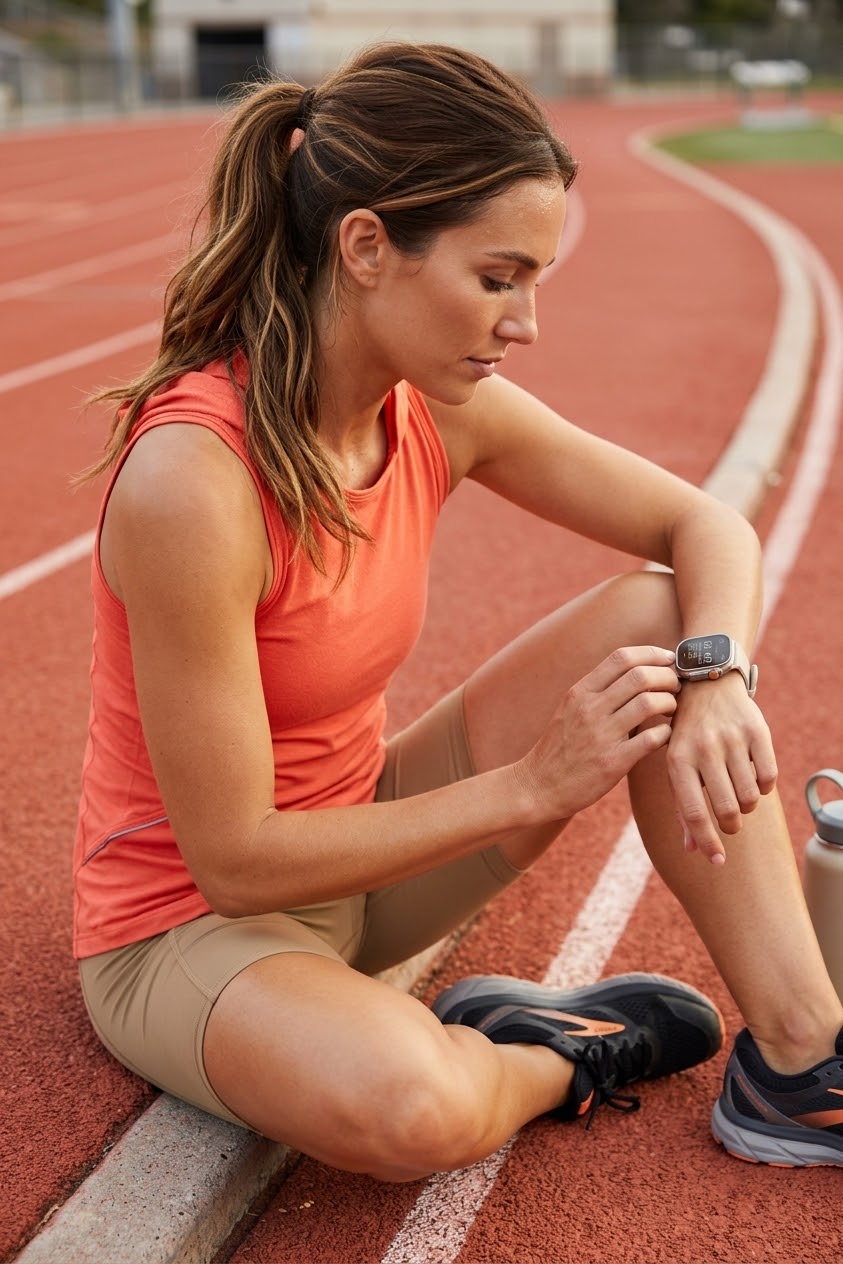
Your Watch Is Guessing: What Different Sports Really Burn—and Why Calories Aren’t the Scoreboard
You finish a great workout.
Sweaty.
Happy.
Legs pleasantly tired.
Then comes the ritual.
You look at your watch.
487 calories.
Nice.
But what exactly does that number mean?
And would the same workout burn 487 calories for your friend?
Probably not.
Here's the part fitness marketing tends to gloss over:
Calorie burn is an estimate.
Sometimes a pretty rough one.
Systematic reviews examining commercial fitness trackers have repeatedly found that energy-expenditure estimates are considerably less reliable than measurements such as steps or, in some circumstances, heart rate. One review of commercially available wearables found that no brand consistently measured energy expenditure accurately. Another meta-analysis found that error varied substantially by device, activity and population.

So your watch isn't necessarily lying to you.
It's estimating.
And that distinction opens the door to a much more interesting question than:
Which sport burns the most calories?
The better question is:
What am I getting for the calories I'm using?
Because 300 calories spent walking a golf course and 300 calories spent lifting weights are not physiologically identical experiences.
Neither is superior simply because one number is larger.
That's where this gets fun.
Meet the Woman Who Helped Give Exercise a Number
If we're going to talk calories, there's one expert worth knowing.
Dr. Barbara Ainsworth, Regents Professor Emerita at Arizona State University, is one of the world's leading experts in physical-activity measurement and the lead author behind the Compendium of Physical Activities. Her research has included physical-activity epidemiology, exercise assessment and physical activity in women.
The latest 2024 Adult Compendium of Physical Activities contains energy-cost estimates for more than 1,100 activities—from running and swimming to horseback riding, golf, yoga and weight training.
Researchers express those activities using METs, or metabolic equivalents.
One MET roughly represents resting energy expenditure.
An activity rated at 5 METs uses approximately five times the energy associated with that standard resting value.
But here's the important part:
Even the Compendium's creators caution that its standard MET values were developed primarily to classify and compare physical activity—not to tell an individual person exactly how many calories she personally burned. Age, body mass, height, sex, lean mass, fitness, technique and individual metabolism can all influence actual energy expenditure.
So think of the numbers below as useful estimates—not receipts from your metabolism.
So...How Many Calories Do Different Sports Actually Use?
To make the comparison useful, we calculated approximate 60-minute energy expenditure using MET values from the 2024 Adult Compendium.
The table shows estimates for women weighing approximately 140, 160 and 180 pounds.
| Activity | Approx. intensity used | 140 lb | 160 lb | 180 lb |
|---|---|---|---|---|
| Golf — walking & carrying clubs | 4.3 METs | ~287 | ~328 | ~369 |
| Tennis — doubles | 4.5 METs | ~300 | ~343 | ~386 |
| Tennis — singles | 8.0 METs | ~533 | ~610 | ~686 |
| Horseback riding — general | 5.5 METs | ~367 | ~419 | ~472 |
| Racquetball — general | 7.0 METs | ~467 | ~533 | ~600 |
| Yoga — general | 2.3 METs | ~153 | ~175 | ~197 |
| Power yoga | 4.0 METs | ~267 | ~305 | ~343 |
| Aerobics — general | 7.3 METs | ~487 | ~556 | ~626 |
| Running — 6 mph / 10-min mile | 9.3 METs | ~620 | ~709 | ~797 |
| Weight training — general | 3.5 METs | ~233 | ~267 | ~300 |
| Vigorous weight lifting | 6.0 METs | ~400 | ~457 | ~514 |
| Recreational freestyle swimming | 5.8 METs | ~387 | ~442 | ~497 |
These estimates use the Compendium's standard calorie-conversion method. Actual expenditure can vary considerably.
And that's exactly why the next part matters.
If Running Burns More Than Yoga, Does That Make Running “Better”?
No.
And this is where calorie-focused exercise advice gets into trouble.
At roughly a 10-minute-mile pace, running carries a Compendium value of 9.3 METs. General yoga is listed around 2.3 METs.
If calories were the only score that mattered, we'd simply tell everyone to run.
But what if you need mobility?
Balance?
Breathing control?
Recovery between hard training days?
What if yoga is the activity you genuinely love and therefore practice four times every week?
Or what if running aggravates an existing issue while swimming feels fantastic?
A workout's value extends far beyond the amount of energy used while you're doing it.
Calories measure energy expenditure. They do not measure the complete value of movement.
Let's prove it.

Golf: The Sneaky Endurance Day
Golf rarely gets invited into calorie-burning conversations.
It should.
Walking the course while carrying clubs is listed at approximately 4.3 METs, while using a cart drops the activity closer to 3.5 METs.
That distinction is interesting.
The golf swing may receive all the attention, but walking 18 holes can mean hours on your feet.
What golf gives you beyond calories is equally valuable: rotational coordination, balance, walking endurance, time outdoors, skill development and a social environment that keeps many women coming back week after week.
And duration matters.
An activity with a moderate hourly calorie cost performed for several hours can accumulate substantial overall energy expenditure.
SportPort takeaway: If you love golf, walk when it's appropriate for you. Your round becomes movement without ever feeling like treadmill duty.

Tennis: Doubles and Singles Are Almost Different Workouts
Here's one of our favorite surprises.
The Compendium assigns doubles tennis approximately 4.5 METs, while singles can reach around 8 METs.
Why such a difference?
Court coverage.
Singles asks you to accelerate, decelerate, move laterally, recover position and cover considerably more space yourself.
But both formats give you something a treadmill cannot:
Reaction.
Hand-eye coordination.
Agility.
Decision-making.
Rotation.
Competition.
Social connection.
And possibly the motivation to chase a ball you would absolutely refuse to chase if someone simply called it “cardio.”
That's the beauty of sport.

Horseback Riding: Yes, the Rider Is Working
We've covered this before in our equestrian series, but the calorie data makes the point beautifully.
General horseback riding is listed at approximately 5.5 METs.
Trotting rises to roughly 5.8 METs.
Cantering or galloping is listed around 7.3 METs, while jumping can reach approximately 9 METs.
So much for “the horse does all the work.”
Riding asks for continual core stabilization, postural control, hip movement, leg endurance, coordination and balance.
And then there's everything around the ride.
The same Compendium lists grooming, saddling and horse-maintenance activities at approximately 4.5 METs.
Anyone who has spent an entire morning at a barn already knew that.
Now you have numbers.

Racquetball: The Calorie-Burning Sleeper
Racquetball doesn't get nearly enough attention.
General play is listed at approximately 7 METs, while competitive racquetball reaches around 10 METs.
That's serious movement.
But the real appeal isn't simply the calorie figure.
Racquetball challenges explosive acceleration, reaction time, coordination, lateral movement and repeated changes of direction.
You aren't thinking:
“I should burn another 75 calories.”
You're thinking:
“Get to the ball.”
That difference can turn hard exercise into play.
And play is underrated.
Yoga: The Perfect Example of Why Calories Aren't the Scoreboard
If we ranked workouts entirely by calorie expenditure, yoga would lose.
General yoga is approximately 2.3 METs, while power yoga is closer to 4 METs.
And yet removing yoga because it doesn't “burn enough” would miss the point entirely.
Yoga can challenge mobility, muscular endurance, balance, body awareness, controlled breathing and movement quality.
It can also make an excellent lower-intensity complement to running, tennis, cycling or strength training.
Some workouts exist to push capacity.
Others help you maintain the mobility and control that allow you to keep using that capacity.
Both matter.
Aerobics: Still a Cardiovascular Powerhouse
Remember aerobics?
It never really left.
General aerobic exercise is listed around 7.3 METs, with vigorous aerobic dance around 8 METs. (Compendium of Physical Activities)
The modern version might be dance cardio, step, Zumba, conditioning classes or another group format.
Beyond energy expenditure, aerobics can challenge cardiovascular fitness, coordination, rhythm and muscular endurance.
There is also something psychologically powerful about exercising with other people.
Music comes on.
Everyone starts moving.
Suddenly you've been exercising for 45 minutes and nobody had to stare at a treadmill timer.
We're calling that a win.
Running: Yes, It Burns a Lot—But That's Not Its Only Value
Running earns its reputation.
A 10-minute-mile pace is approximately 9.3 METs, while faster running rises considerably from there.
For many women, running provides cardiovascular conditioning, endurance, bone-loading stimulus, outdoor time, stress relief and the deeply satisfying knowledge that your own body carried you from point A to point B.
But higher energy expenditure also means something else:
You need to fuel it.
This is especially important for active women.
The updated 2025 Female Athlete Triad Coalition Consensus Statement emphasizes that chronic energy deficiency can affect reproductive function and bone health, including the risk of bone stress injury.)
So knowing that your long run uses substantial energy shouldn't prompt:
“Great—now I can eat less.”
It should prompt:
“My body did significant work today. I need to recover from it.”
That's a far healthier use of calorie information.
Weight Lifting: Where the Calorie Number Misses the Point Completely
Strength training may be the best example in this entire article.
General resistance training with multiple exercises is approximately 3.5 METs, while vigorous lifting is closer to 6 METs.
So a moderate lifting workout may use fewer calories during the session than a hard run.
Does that make running better?
Absolutely not.
They're doing different jobs.
Strength training asks your body to become stronger.
It provides progressive mechanical loading that cardio alone cannot replicate in the same way.
For women moving through their 30s, 40s and 50s, maintaining strength becomes increasingly relevant to everyday function, sports performance and long-term physical capability.
If you judged your lifting workout only by the calorie number on your watch, you could easily underestimate one of the most valuable things you did all week.
Not every workout needs to win the calorie contest.

Swimming: Quietly Working Almost Everything
Recreational freestyle swimming is listed around 5.8 METs, while vigorous freestyle can reach approximately 9.8 METs. (Compendium of Physical Activities)
Swimming combines cardiovascular work with repeated upper- and lower-body movement while water reduces weight-bearing impact.
It challenges breathing control, coordination, endurance and whole-body rhythm.
And because technique matters enormously, two women swimming for 45 minutes may have very different physiological experiences.
Which brings us back to the watch.
Your body isn't an algorithm.
Why Two Women Can Play the Same Sport and Burn Different Calories
Put two women on the same tennis court for an hour and their calorie expenditure may differ.
Why?
Body size matters.
Fitness matters.
Movement efficiency matters.
Skill matters.
Intensity matters.
Rest periods matter.
Temperature can matter.
Terrain can matter.
Even technique can change how much energy an activity requires.
A beginner swimmer may expend enormous effort moving slowly because her technique is inefficient.
An experienced swimmer may travel farther with less wasted energy.
A novice rider may brace constantly while an experienced equestrian moves more efficiently with the horse.
The Compendium of Physical Activities itself warns against treating standard MET values as precise individual prescriptions because resting metabolic rate varies with age, body size, sex and lean mass.
That is why we prefer ranges and context over false precision.
Why Women Should Know Their Exercise Energy Cost
Not because we're asking women to obsess over calories.
Quite the opposite.
Understanding exercise energy expenditure can help you make better decisions.
It can explain why you're ravenous after a long run.
Why a two-hour singles match leaves you drained.
Why an entire horse-show day feels more physically demanding than your watch suggests.
Why heavy training weeks may require more food and recovery than lighter weeks.
Why walking the golf course counts.
And why a lower-calorie yoga session may be exactly what your body needs between harder days.
For active women, calorie awareness should support fueling and recovery, not punishment.
That distinction matters.
The 2025 Female Athlete Triad update reinforces that persistent energy deficiency can affect women's reproductive and skeletal health.
Your body needs energy not just for exercise.
It needs energy to run everything else.
Try the SportPort “What Did I Get?” Test
After your next workout, resist the urge to ask only:
How many calories did I burn?
Ask instead:
What did I get?
After tennis:
Agility. Coordination. Cardio. Competition.
After riding:
Balance. Core control. Connection.
After yoga:
Mobility. Stability. Recovery.
After golf:
Walking. Rotation. Outdoor time.
After racquetball:
Speed. Reaction. Power.
After running:
Endurance. Cardiovascular conditioning.
After weights:
Strength. Load tolerance. Capability.
After swimming:
Whole-body endurance. Breath control. Low-impact conditioning.
Now the calorie number becomes one piece of information instead of the definition of success.
That's a much more useful relationship with exercise.
The Highest-Calorie Sport Isn't Necessarily Your Best Sport
Suppose running burns 700 calories for one woman while horseback riding uses 420.
Should she stop riding and start running?
Of course not.
What if she hates running?
What if she rides four days every week because she loves it?
The activity you consistently return to has an enormous advantage over the theoretically “better” activity you abandon after three weeks.
Our advice at SportPort Active has always been simple:
Move in ways that make you want to keep moving.
Run.
Ride.
Lift.
Swim.
Golf.
Play tennis.
Try racquetball.
Practice yoga.
Take an aerobics class.
Walk.
Hike.
Cycle.
Do several.
Your body benefits from variety anyway.
And your life becomes considerably more interesting when fitness isn't restricted to one room filled with machines.
Your Watch Can Count Calories. It Can't Count Everything.
Your watch may estimate that today's workout burned 412 calories.
Useful?
Sure.
The complete story?
Not even close.
It cannot measure the confidence you gained learning to ride.
The friendships built on the tennis court.
The strength that lets you carry your own luggage.
The balance developed in yoga.
The feeling of finishing your first 10K.
The hand-eye coordination sharpened during racquetball.
The afternoon spent outdoors walking a golf course.
The satisfaction of adding five pounds to your deadlift.
Or the calm that arrives after swimming twenty quiet laps.
Those benefits don't appear on the calorie screen.
But they count.
At SportPort Active, we believe movement should add something to your life—not simply subtract calories from it.
So use the numbers.
Learn from them.
Fuel appropriately.
Recover intelligently.
Then look beyond them.
Because the best sport isn't necessarily the one that burns the most calories.
It's the one that gives you the most reasons to keep moving.
Read more

A strong morning starts with how you fuel your body. Learn how to match breakfast to your sport, training intensity, and schedule with SportPort Active’s Energy Ladder framework.

Discover how different sports can complement one another—building strength, balance, endurance, mobility, coordination and performance across an active life.